
Selecting Sheet Rolls for Toy Blister Packs: An Application Guide
Sheet roll selection for toy blister packs comes down to four properties: clarity after forming, forming definition at the deepest draw, impact resistance through handling and transit, and appearance consistency from the first pack of a run to the last. When those four are matched to the thermoforming line, die-cutting and card sealing usually run cleanly. When they are not, a sheet that looks flawless as a flat sample will crack at a clamshell corner, haze over a display window, or generate scrap at the sealing station.
This guide is written for toy brand owners, OEM toy manufacturers, packaging buyers and thermoforming production managers evaluating thermoforming plastic sheet roll supply for carded blisters, action-figure clamshells, transparent display packs and window patches. It covers the sheet requirements that drive retail appearance and pack integrity, the roll-to-sealed-pack workflow, and the specification checks that keep repeat orders stable.
The reference supply case throughout is PULIXIN Thermoforming Plastic Sheet, manufactured by Pulixin Packaging Materials (Shanghai) Co., Ltd., a rigid plastic sheet manufacturer founded in 2009 that produces PET, PP and HIPS sheet rolls on 14 co-extrusion lines. A documented toy clamshell program in Germany and the United States is used to show how sheet decisions translate into measurable results at the packing line.
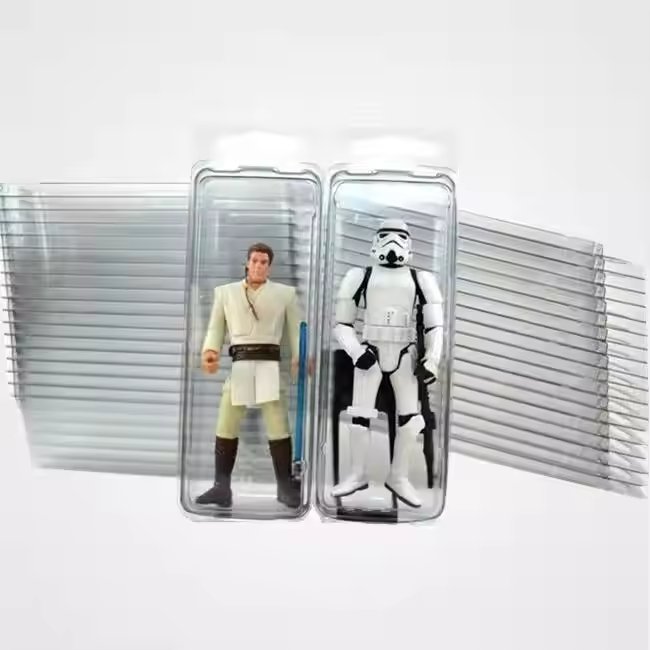
Problem Definition: Where Toy Blister Packs Actually Fail
Toy blister defects are rarely random. Across thermoformed toy packaging, the same failure points repeat, and most of them trace back to a sheet decision made before the mold was mounted.
- Corner and flange cracking on clamshells. The deepest area of a clamshell draws material from the flange and sidewalls. If initial thickness, draw ratio and heating profile are not balanced, the wall thins below the level needed for the drop and squeeze loads a toy pack receives.
- Clarity loss after forming. Transparency measured on a flat sheet is not the same as transparency in a formed cavity. Temperature control, surface quality and material structure determine whether a display window stays glass-clear or turns hazy.
- Transit cracking on carded blisters. Brittle behavior shows up as cracked flanges and split hang tabs after shipping and retail handling, not at the forming machine.
- Die-cut misregistration. Thickness variation and poor sheet flatness shift the cut relative to the printed card or the formed cavity, increasing trim scrap.
- Sealing scrap. A narrow heat-sealing window forces operators to run close to the edge, producing incomplete seals, card deformation or rejected packs.
- Appearance drift between lots. Small differences in color, gloss or haze become visible when two production lots sit side by side on the same retail shelf.
Industry Background: Why Retail Visibility Sets the Sheet Spec
Toy blister packaging sits inside a large and still-growing thermoformed plastics category. Grand View Research valued the global thermoformed plastic market at USD 14.79 billion in 2023 and projected a 4.9% CAGR for 2024-2030. Market figures from different research houses are not directly comparable, because some measure raw thermoformed sheet materials and others measure finished thermoformed products, so the scope of a market number should always be confirmed before it is used in a business case.
Three practical conditions shape toy packaging specification work:
- Classification for importers. Thermoforming plastic materials are classified under HS Code Heading 3920 for non-cellular sheet and 3921 for cellular sheet. Correct classification matters for anyone importing sheet roll for a toy packaging program.
- Process temperature. PET thermoforming typically occurs between 266°F and 320°F (130°C to 160°C), according to South Plastic (SPI). Where a sheet sits in that window, and how evenly it reaches it, decides how much mold detail the material can reproduce before it stretches thin or whitens.
- Recycled content pressure. The recycled PET (rPET) market is projected to reach USD 24.6 billion by 2034 (Dataintelo). Recycled content increasingly enters packaging specifications through chain-of-custody programs rather than through material name alone; the Global Recycled Standard covers processed post-consumer and pre-consumer materials and the extrusion process, which is why PULIXIN holds GRS scope certificate SGC-GRC09372-GRS-2026-04.
In toy packaging specifically, the commercial logic is straightforward: the pack is usually the last thing a shopper looks at before picking a product off the shelf. Transparency, forming definition and finish consistency are therefore purchasing variables, not cosmetic details.
The Four Sheet Requirements for Toy Blister Packs and Clamshells
1. Transparency that survives the forming step
Clear sheet should not be selected on flat-sheet transparency alone. Buyers need to weigh required clarity together with stiffness, forming depth, impact performance, temperature conditions, sealing or printing requirements, and the finished package. PET is widely used for high-clarity thermoformed packaging, and the exact PET structure and specification should be chosen according to the application rather than by visual impression.
In toy formats, clarity has three separate jobs: showing the product inside a clamshell, keeping a window patch or display pack readable, and preserving printed graphics that sit behind the sheet. PULIXIN supplies transparent and customized color options across its PET range, and surface treatments such as hard coating, silicon coating, corona treatment, laminated film or coating can be applied where a toy pack needs them.
2. Forming definition and wall distribution
Forming definition is the ability to reproduce mold detail, such as facial features on a figurine cavity, a sharp clamshell edge or a crisp hang-tab radius, without thinning the material past its performance limit. For deep-draw parts, nominal thickness alone is not enough information. What matters is how material distributes from the flange and sidewalls into the deepest area during forming, which depends on material formability, initial thickness, draw ratio, mold geometry, corner radius and heating uniformity.
A sheet that forms well in a shallow carded blister may not be suitable for a much deeper collector clamshell. The practical rule is to specify from the finished part drawing backward, then confirm the specification on the actual machine.
3. Impact resistance for handling, transit and drop tests
Toy packs are handled roughly, in transit, on pallets, in retail bins and by customers who pick a pack up by the hang tab. Impact performance should therefore be defined against the real abuse the pack receives rather than against a general impression of stiffness. HIPS is a high impact polystyrene material and is documented as suitable for blister packaging and electronics packaging, while PET combines clarity and stiffness with impact performance that can be tuned through structure and thickness.
4. Consistent appearance across the run
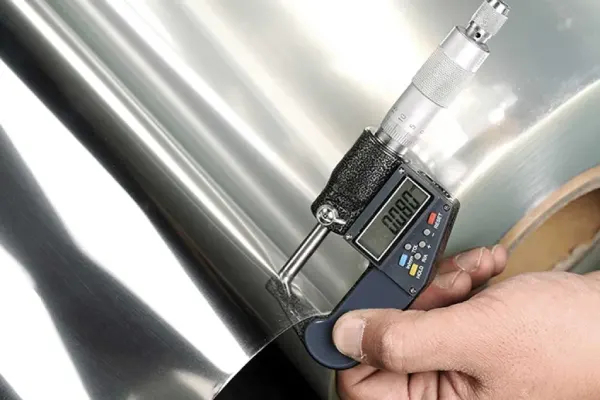
Consistency is what separates a good sample from a reliable supply program. Thickness tolerance, width accuracy, transparency, flatness and mechanical properties all need to hold batch to batch, because appearance drift and forming drift show up later as retail complaints and as scrap. This is a quality-control question as much as a material question: PULIXIN quality control covers raw material inspection, thickness and width control, appearance inspection, in-process quality control and finished-product inspection, with third-party testing available when required.
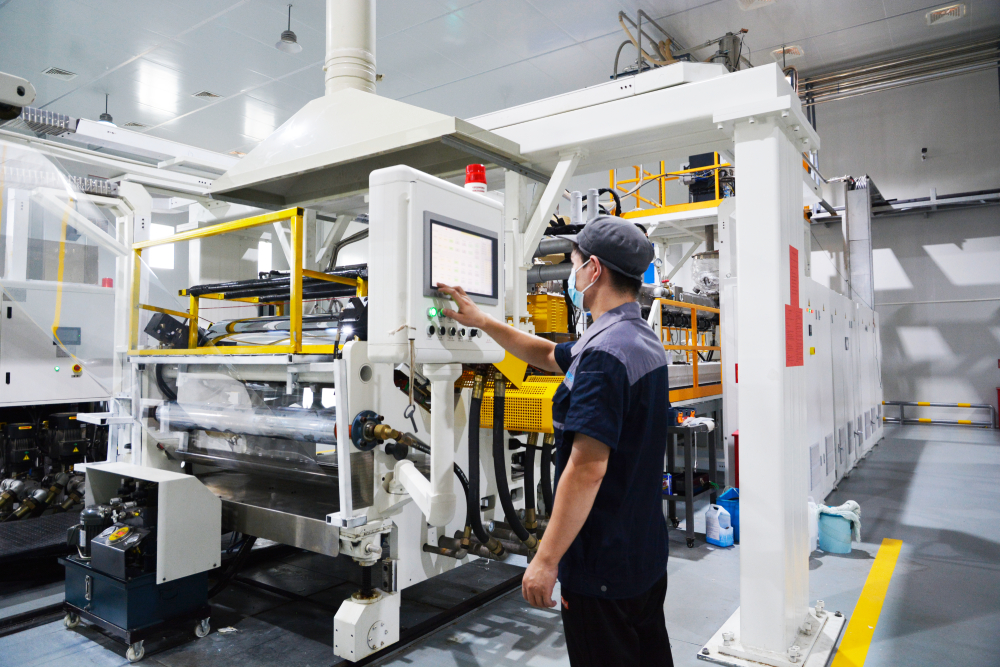
Detailed Solution: Configuring PULIXIN Sheet Rolls for a Toy Blister Program
Material options
PULIXIN manufactures PET, PP and PS/HIPS thermoforming sheet rolls, alongside food-grade versions for applications where food contact is involved. The PET range includes APET thermoforming sheet roll, rPET thermoforming sheet roll, GAG sheet roll, PETG sheet roll, food grade PET sheet roll, transparent PET sheet roll, and functional variants such as anti-fog, anti-block, anti-scratch and anti-static ESD PET sheet. The HIPS range includes normal HIPS sheet roll, conductive black HIPS sheet roll, antistatic HIPS sheet roll, high and low temperature resistant HIPS sheet roll, and light blocking HIPS sheet roll. The PP range includes normal PP sheet roll, conductive black PP sheet roll, antistatic PP sheet roll, PP/PE thermoforming sheet and high and low temperature resistant PP sheet roll.
For toy blister and clamshell formats, the documented reference case uses PET, but material choice should follow the finished pack: forming depth, required clarity, temperature exposure, sealing method and cost target.
Sheet parameters
Documented customized specifications for the three main materials:
- PET Thermoforming Plastic Sheet Roll: thickness 0.18-1.7 mm, width 250-1400 mm, transparent or customized color, roll size 50-800 kg/roll, mono-layer or multi-layer structure, vacuum forming or pressure forming.
- PP Thermoforming Sheet Roll: thickness 0.3-2 mm, width 300-900 mm, natural, white, black or customized color, mono-layer or multi-layer structure, vacuum forming or pressure forming.
- HIPS Thermoforming Sheet Roll: thickness 0.24-2 mm, width 300-900 mm, natural, white, black or customized color, glossy or matte surface, mono-layer or multi-layer structure, vacuum forming or pressure forming.
Roll width should be set from mold layout, product arrangement, trim allowance and the usable width of the forming machine, while roll diameter, roll weight and core size must stay compatible with the unwinding system. Correct roll specifications reduce edge trim waste and prevent feeding or handling problems.
OEM and custom manufacturing
PULIXIN provides OEM and custom manufacturing production services for thermoforming plastic sheets. Customization covers material (PET, PP, PS/HIPS), thickness, width, color, transparency, surface finish, roll size, functional properties, and packaging and labeling. In practice, a toy packaging buyer can define the clarity level, the exact forming width, the roll weight that fits the unwinder, and any special surface behavior in one specification.
Quality control and documentation
Documented quality control covers raw material inspection, thickness and width control, appearance inspection, in-process quality control and finished-product inspection, with third-party testing available on request. Third-party documentation held for the relevant materials includes:
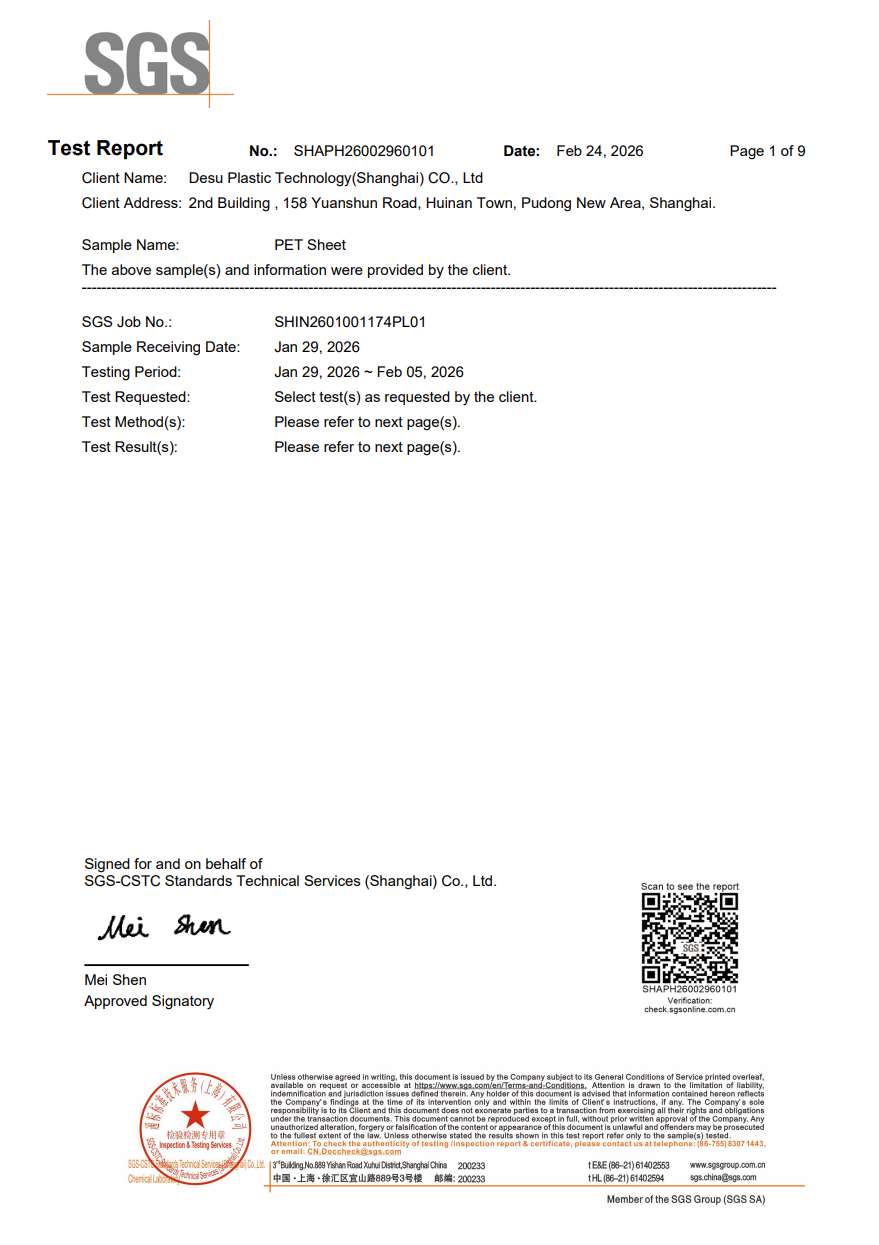
- SGS test report for PET sheet, certificate SHAPH26002960101, referencing EU RoHS Directive (EU) 2015/863.
- SGS test report for PP white (natural) sheet, SHAPH26002958405, referencing EU RoHS Directive (EU) 2015/863.
- SGS test report for PS white (natural) plastic sheet, SHAPH26002958401, referencing EU RoHS Directive (EU) 2015/863.
- SGS test report for PS black plastic sheet, SHAPH26002958403.
- ISO 9001:2015 Quality Management System certificate 00226Q03336R101 (CQM), covering the production of polyester sheets (PET).
- ISO 14001:2015 Environmental Management System certificate 00226E02412R101 (CQM).
- Global Recycled Standard scope certificate SGC-GRC09372-GRS-2026-04 (SGS), covering processed post-consumer and pre-consumer materials and the extrusion process.
- FSSC 22000 certificate CQM25FSSC00171 for the production of specific PET sheets for food contact applications.
All SGS reports listed above were issued by SGS-CSTC Standards Technical Services (Shanghai) Co., Ltd. Buyers should confirm which document set applies to their material and destination market before the first production order.
Capacity, lead time and order quantities
PULIXIN operates 14 advanced co-extrusion production lines on a 20,000 square meter production base, with annual output exceeding 40,000 tons and a monthly production capacity of approximately 3,500 tons, which may vary depending on production schedule and product specifications. Documented order terms:
- MOQ: standard PET 5 tons; standard PP/PS 3 tons; customized products may be subject to different MOQ requirements.
- Lead time: generally 7 to 15 days, depending on material, specifications, order quantity and customization requirements.
- Delivery terms: EXW, FOB and CIF, with other Incoterms available upon agreement.
- Acceptance criteria: specification verification, thickness and width inspection, appearance inspection and finished-product quality inspection before shipment, with third-party inspection available upon request.
Export experience covers more than 55 countries, with documented markets including Europe, North America, South America, the Middle East, Southeast Asia and Africa.
Step-by-Step Breakdown: From Sheet Roll to Sealed Toy Blister Pack
A toy blister program is a sequence of dependent decisions. Each step below lists the sheet-level control point that most often determines whether the next step runs cleanly.
| Step | What happens | Sheet-level control point |
|---|---|---|
| 1. Define the finished pack | Pack format, cavity geometry, forming depth, retail display requirement and printed areas are fixed. | Work backward from the finished part; specify material, thickness and clarity from the drawing or a physical sample. |
| 2. Specify the roll | Roll width, diameter, weight and core are set against the mold layout and the unwinding system. | Roll width follows mold layout plus trim allowance; roll diameter, weight and core size must suit the unwinder. |
| 3. Select material and thickness | PET, PP or HIPS is chosen with a starting thickness. | Draw ratio, corner radius, required minimum wall thickness and stiffness determine the starting thickness. |
| 4. Unwind and heat | Sheet is fed from the roll and heated to forming temperature. | Flatness, winding condition and storage history affect how evenly the sheet heats; PET forms in the 266-320°F (130-160°C) range. |
| 5. Vacuum forming or pressure forming | The heated sheet is drawn onto the mold by vacuum, or assisted by pressure, to reproduce cavity detail. | Forming definition depends on material formability, heating uniformity, draw depth and mold geometry, not on thickness alone. |
| 6. Cooling and de-molding | The formed part is cooled and released from the mold. | Consistent thickness and stable forming conditions control shrinkage, warping and dimensional repeatability. |
| 7. Die-cutting and trimming | Formed parts are cut from the web, and flange or hang-tab profiles are trimmed. | Thickness tolerance and sheet flatness directly affect cut registration and trim scrap. |
| 8. Sealing | The blister or clamshell is heat-sealed to a printed card, or a window patch is applied. | A stable heat-sealing window and a consistent surface finish keep seals complete without deforming the card. |
| 9. Inspection and packing | Finished packs are inspected and packed for shipment. | Appearance inspection and finished-product inspection catch drift before it reaches the retail shelf. |
Two process decisions deserve separate attention because they are frequently blamed on the material:
- Cracking or whitening at forming. PET thermoforming problems are not always caused by the sheet. Cracking, whitening and incomplete forming can result from unsuitable or uneven heating, excessive forming depth, sharp mold geometry, material condition or a sheet specification that is not suitable for the forming depth. Sheet, mold, heating profile and forming parameters should be checked together before changing materials.
- Sealing performance. Sealing scrap is a joint outcome of sheet surface, thickness consistency and sealing-window width. Optimizing the sealing window is often what converts a marginal pack into a stable one.
Use Cases: Toy Blister, Clamshell and Transparent Display Formats
The formats below are the ones most often specified with thermoforming sheet roll in toy packaging, and each puts a different weight on the four sheet requirements.
- Action-figure clamshells. Deep draws with a visible product, high clarity demand and a real drop-load requirement. Forming definition and impact resistance matter most.
- Carded blisters. Shallow formed cavities sealed to printed board. Sealing-window stability, die-cut registration and flange integrity matter most.
- Window patches and transparent display packs. Flat or lightly formed sheet that must stay clear and printable while protecting graphics.
- Collector display cases. Larger, stiffer shapes where appearance consistency across a production run is as important as the single-unit look.
Documented reference case: toy brand owner and OEM toy manufacturer, Germany and the United States. A toy brand owner and OEM toy manufacturer uses approximately 800 tonnes per year of PULIXIN PET Thermoforming Plastic Sheet Roll for action-figure clamshells, carded blisters, window patches and collector display cases. The program has run for three years in Germany and two years in the United States. Reported results: drop-test cracking reduced from 3.2% to 0.4%, sealing scrap reduced by 18%, 24 consecutive months of on-time delivery, and a rating of excellent for shelf visibility in retail audits. The documented material highlights for this application are high impact strength, transparency, fast and stable heat-sealing, and a printable surface.
The same sheet families also serve packaging categories where other requirements dominate. Programs where the pack must meet food-contact requirements should be specified against food-contact documentation such as the FSSC 22000 scope and the relevant SGS report, and PULIXIN also supplies food-grade PP sheet rolls for frozen food tray applications with impact-resistant copolymer options.
PET, PP and HIPS Sheet Rolls for Toy Packaging: Attribute Comparison
The table below compares the three materials using documented PULIXIN specification data. Ranges are customized values, not fixed stock sizes.
| Attribute | PET Thermoforming Plastic Sheet Roll | PP Thermoforming Sheet Roll | HIPS Thermoforming Sheet Roll |
|---|---|---|---|
| Base material | PET / APET / rPET | Polypropylene (PP) | Polystyrene (PS) / high impact polystyrene (HIPS) |
| Thickness (customized) | 0.18-1.7 mm | 0.3-2 mm | 0.24-2 mm |
| Width (customized) | 250-1400 mm | 300-900 mm | 300-900 mm |
| Color | Transparent / customized | Natural / white / black / customized | Natural / white / black / customized |
| Surface | Depends on requirement (hard coated, silicon-coated, corona treatment, laminated film, coating) | Depends on requirement | Glossy / matte |
| Structure | Mono-layer / multi-layer | Mono-layer / multi-layer | Mono-layer / multi-layer |
| Thermoforming process | Vacuum forming / pressure forming | Vacuum forming / pressure forming | Vacuum forming / pressure forming |
| Roll size | 50-800 kg/roll (customized) | Customized | Customized |
| Documented applicable industries | Food packaging, fresh produce packaging, meat packaging, bakery packaging, pharmaceutical packaging, electronics packaging, blister packaging | Food packaging, disposable cup manufacturing, dairy packaging, takeaway food packaging, industrial packaging | Food packaging, blister packaging, electronics packaging, industrial thermoforming |
| Third-party test reference | SGS SHAPH26002960101 (EU RoHS Directive 2015/863) | SGS SHAPH26002958405, PP white (natural), EU RoHS Directive 2015/863 | SGS SHAPH26002958401, PS white (natural); SGS SHAPH26002958403, PS black |
Among the documented PULIXIN reference programs, the toy clamshell and carded blister case in Germany and the United States runs on PET Thermoforming Plastic Sheet Roll. Material selection for a new toy program should still start from the pack: forming depth and stiffness requirements, required clarity, temperature exposure during storage and transport, sealing or printing method, and the compliance documents the destination market requires.
FAQ: Sheet Rolls for Toy Blister Packs
What documentation supports PULIXIN sheet rolls for retail toy packaging programs?
PULIXIN holds SGS test reports for PET sheet (SHAPH26002960101), PP white (natural) sheet (SHAPH26002958405), PS white (natural) plastic sheet (SHAPH26002958401) and PS black plastic sheet (SHAPH26002958403); the PET, PP white and PS white reports reference EU RoHS Directive (EU) 2015/863. System-level documentation includes ISO 9001:2015 certificate 00226Q03336R101 covering the production of polyester sheets (PET), ISO 14001:2015 certificate 00226E02412R101, Global Recycled Standard scope certificate SGC-GRC09372-GRS-2026-04, and FSSC 22000 certificate CQM25FSSC00171 for the production of specific PET sheets for food contact applications. Buyers should match the document set to the material ordered and to the destination market requirement, because toy packaging and food-contact packaging are governed by different requirements.
Can PULIXIN customize sheet rolls for a specific clamshell or blister geometry?
Yes. OEM and custom manufacturing services cover material choice (PET, PP, PS/HIPS), thickness, width, color, transparency, surface finish, roll size, functional properties, and packaging and labeling. Documented customized ranges are PET 0.18-1.7 mm thickness with 250-1400 mm width, PP 0.3-2 mm with 300-900 mm, and HIPS 0.24-2 mm with 300-900 mm. Customization should be driven by the finished pack, meaning forming depth, mold layout, trim allowance, clarity requirement and sealing method, rather than by nominal thickness alone.
Which sheet material should be used for a clear toy clamshell or carded blister?
PET is commonly preferred for clear trays, clamshells and blister packaging because of its transparency and stiffness, and PET Thermoforming Plastic Sheet Roll is the material documented in the PULIXIN toy clamshell and carded blister reference program. HIPS is also documented as suitable for blister packaging, with glossy or matte surfaces available. Selection should consider forming depth, stiffness, impact requirement, temperature conditions, printing or sealing requirements and the required compliance documents, not transparency alone.
What MOQ, lead time and capacity apply to a toy packaging sheet order?
MOQ varies by material and specification: standard PET 5 tons, standard PP/PS 3 tons, and customized products may be subject to different MOQ requirements. Lead time generally ranges from 7 to 15 days depending on material, specifications, order quantity and customization requirements. Monthly production capacity is approximately 3,500 tons, which may vary depending on production schedule and product specifications, across 14 co-extrusion lines with annual output exceeding 40,000 tons. Delivery terms include EXW, FOB and CIF, and acceptance covers specification verification, thickness and width inspection, appearance inspection and finished-product quality inspection before shipment.
How should a new toy blister sheet specification be validated before mass production?
Start from the finished part: provide the drawing or a physical sample, forming depth, part dimensions, transparency or color requirement, machine information and performance requirements. Where a proven specification already runs on the line, use it as the baseline and change only what is necessary, because changing material structure, thickness and process settings at the same time makes the source of any difference impossible to identify. Then run a controlled production trial before moving to regular-volume orders. PULIXIN provides technical support for material selection and thermoforming application, and samples or a quotation can be requested directly through the contact details below.
Conclusion: Specify the Sheet Before the Mold Goes On
Toy blister and clamshell programs are won or lost at the sheet specification stage. Clarity that survives forming, forming definition at the deepest draw, impact resistance against real handling abuse, and appearance consistency across repeat lots are the four levers that determine how a pack looks on the shelf and how it performs in transit. Die-cutting and sealing are downstream consequences of those decisions, not separate problems to be solved later.
The documented PULIXIN toy program shows what a matched specification looks like in practice: approximately 800 tonnes per year of PET Thermoforming Plastic Sheet Roll for a toy brand owner and OEM toy manufacturer in Germany and the United States, with drop-test cracking reduced from 3.2% to 0.4%, sealing scrap down 18%, and 24 consecutive months of on-time delivery.
Specifying sheet rolls for a toy blister pack program? Share the finished-part drawing, forming depth, machine width and required clarity, and the PULIXIN technical team will recommend a starting material, thickness and roll specification before you commit to a mold trial.
- Catalogue download: PULIXIN DESU NEW Catalogue (PDF)
- Website: www.pulixin.com
- Email: operation01@pulixin.com
- Tel / WhatsApp: +86 13818585204
- Contact: Carrie
- Address: No.32 Lubin Rd, Luyuan Industrial Zone, Pudong, Shanghai, China
Have Questions or Need More Details?
Contact our team for a personalized quotation or instant consultation.
Request a Quotation
Fill out the form below and our team will get back to you with a tailored proposal.
WhatsApp Direct Chat
Prefer to chat in real-time? Message us on WhatsApp for instant assistance & quick answers.
- Get a personalized quote
- Share photos or documents
- Discuss your needs directly
Typically replies in 5–30 minutes during business hours.