
Thermoforming Sheet Roll Parameters for Blister Packaging: A Technical Guide
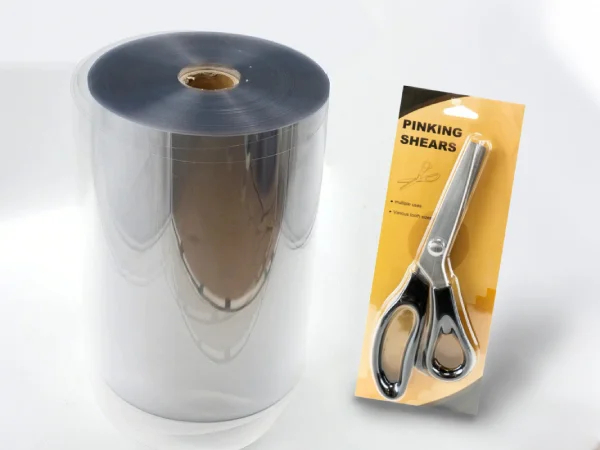
Direct answer: On a roll-fed blister packaging line, three sheet-roll parameters have to be specified together — roll width, roll diameter (and the roll weight it produces) and core size. Roll width is calculated from the blister mold layout plus edge-trim allowance and must not exceed the usable width of the thermoforming machine. Roll diameter, roll weight and core inner diameter must remain compatible with the unwinding system and the handling equipment. Underneath all three sits thickness consistency and dimensional stability, which determine whether the die-cutting and sealing stations stay in registration at production speed.
This guide explains how those parameters are derived, how they interact with roll-fed thermoforming machines and downstream die-cutting and sealing equipment, and what a buyer should write into a specification before ordering.
Problem Definition: What Actually Breaks When Roll Parameters Are Approximate
Roll geometry serves two systems at the same time: the thermoforming machine that feeds, heats and forms the sheet, and the tooling downstream that die-cuts, stacks and seals the formed web. A specification that satisfies only one of them usually produces problems at the other.
In blister packaging this matters more than in simple tray forming, because forming, die-cutting and sealing positions are all indexed to the same moving web. A parameter that is only slightly wrong at the unwind stand tends to appear as a defect several stations later, which makes the root cause harder to identify.
Roll dimensions should match the customer's thermoforming and feeding equipment. Roll width is normally determined by mold layout, product arrangement and trim allowance, while roll diameter, roll weight and core size must remain compatible with the unwinding system. Correct roll specifications reduce unnecessary trim waste and prevent handling or feeding problems.
When roll parameters are treated as a packaging detail rather than a production parameter, the typical symptoms are:
- Excess edge trim: a roll that is noticeably wider than the cavity layout can produce usable parts, but every extra millimetre becomes scrap.
- Feed and unwinding faults: sheet curl and uneven feeding can be traced to winding stress, material structure, temperature changes and storage conditions before they are traced to the material itself.
- Die-cutting misregistration: when the web is not flat or not wound evenly, the cut position drifts relative to the formed cavity.
- Sealing scrap: sealing windows are narrow on blister lines, so small variations in sheet flatness or thickness distribution show up as seal defects rather than forming defects.
- Unplanned roll changes: a roll diameter or weight that does not suit the unwinding stand forces more frequent stops than the production plan assumes.
None of these are exotic failures. They are the ordinary result of specifying sheet by material name, nominal thickness and price, and leaving roll geometry to be settled at the packing list stage.
Industry Background: Why Blister Packaging Demands Tighter Sheet Discipline
Thermoformed plastic packaging is a large and still expanding category. Grand View Research valued the global thermoformed plastic market at USD 14.79 billion in 2023 and projected a compound annual growth rate of 4.9% for 2024–2030. Recycled content is expanding on a separate track: Dataintelo projects the recycled PET (rPET) market to reach USD 24.6 billion by 2034, which is directly relevant to blister and clamshell programmes that specify recycled material with chain-of-custody documentation.
Two technical facts explain why blister packaging is more sensitive to roll parameters than many other thermoformed products. First, PET thermoforming typically takes place between 266°F and 320°F (130°C to 160°C). That is a workable window, but it is narrow enough that variation in sheet thickness changes how quickly each section of the web reaches forming temperature, which in turn changes how the material draws into the cavity. Second, blister packaging is a regulated packaging format in many destination markets: EU Regulation (EU) No 10/2011 governs plastic materials and articles intended to come into contact with food, so compliance documentation is part of the sheet specification rather than a separate commercial question.
Classification matters as well for buyers importing rolls. Thermoforming plastic materials fall under HS Code Heading 3920 for non-cellular sheet and 3921 for cellular sheet, which affects how a shipment is declared and how the receiving country's duty treatment is applied.
PULIXIN — Pulixin Packaging Materials (Shanghai) Co., Ltd. — is a thermoforming plastic sheet roll manufacturer based in Shanghai, China, producing PET, PP and HIPS rigid sheet rolls for thermoforming applications. The company was founded in 2009, operates a 20,000 m² production base with 14 advanced co-extrusion production lines, produces more than 40,000 tons annually, and exports to 55+ countries across Southeast Asia, the Middle East, South America and Europe, with exports representing about 80% of output. For blister packaging projects, that combination — co-extrusion capacity plus export documentation experience — is what makes a written roll specification enforceable at both ends.
Detailed Solution: Defining Roll Width, Roll Diameter and Core
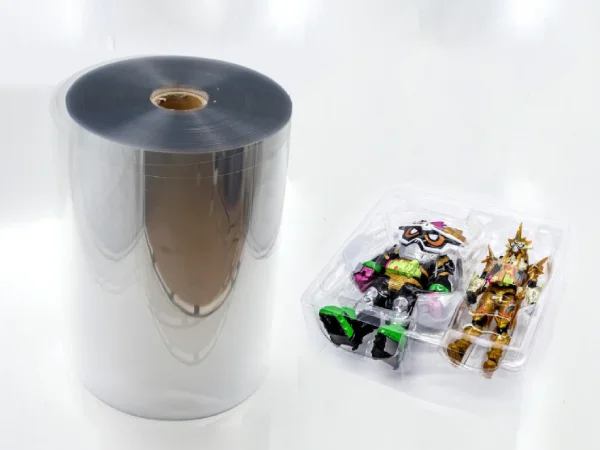
Roll width: derived from the mold, not chosen from a list
Roll width is the usable forming width of the sheet as it enters the machine. It is calculated from three inputs: the cavity layout across the mold, the edge trim that must be left outside the outermost cavity, and the usable width of the thermoforming machine itself. Providing only a target thickness without product and machine information can lead to unnecessary material use or poor forming performance, and roll width should always consider mold layout, product arrangement, edge trim and the usable machine width.
The practical rule is asymmetric. A roll that is too narrow cannot cover the full cavity layout, so it either reduces the number of usable cavities per cycle or is simply unusable. A roll that is too wide still forms, but the surplus becomes trim, and surplus width can also affect web tracking through the guide rollers. For an existing line, the fastest and most reliable approach is to send the current roll specification or the equipment limits to the sheet supplier. For a new mold, calculate the required sheet width from the mold layout plus the necessary trim allowance, then confirm the number against the machine before production.
Customized width capability differs by material, and this is a real constraint when a blister line was originally tooled for one polymer:
- PET Thermoforming Plastic Sheet Roll: width 250–1400 mm, customized.
- PP Thermoforming Sheet Roll: width 300–900 mm, customized.
- HIPS Thermoforming Sheet Roll: width 300–900 mm, customized.
Roll diameter and roll weight: an unwinding-system decision
Roll diameter is not a marketing number. It is the physical interface between the roll and the unwind stand, and it must be compatible with the unwinding system, the maximum roll weight the line can handle, and the lifting or loading method used at the machine. A larger roll diameter reduces the number of roll changes per shift and improves line continuity. It also increases roll weight and rotating inertia, which places more demand on the tension control and on the core itself.
Roll size is customized across the PULIXIN range. PET thermoforming plastic sheet roll is supplied at 50–800 kg/roll with customized dimensions; PP and HIPS sheet rolls are produced with customized roll size. Because roll weight and diameter move together, the buyer should specify the maximum roll weight the unwinding shaft and the loading equipment can accept, not only a preferred diameter.
Core size: the parameter that is most often left blank
Core inner diameter must match the unwinding shaft, and the core must be strong enough to carry the full weight of the wound roll under winding tension without deforming. This is why the core is best treated as an equipment parameter rather than a supplier default: two lines running the same material and the same width can require different cores simply because their unwinding shafts differ.
A complete core specification for a blister project should state the core inner diameter, the winding direction as it will be mounted on the machine, and the handling method. Storage method should follow the supplier's packaging and handling recommendations to avoid roll deformation or edge damage — a deformed core reintroduces exactly the feed and registration problems the specification was written to prevent.
Thickness consistency and thickness tolerance: the two properties everything else depends on
Thickness is usually agreed, but thickness tolerance is frequently left implicit. Thickness variation affects heating, forming consistency, part weight and final wall distribution, which means it propagates directly into die-cutting and sealing performance. A blister that thins unevenly across the cavity can still form, yet seal at a different temperature at one end of the web than at the other.
Customized thickness ranges by material are:
- PET Thermoforming Plastic Sheet Roll: 0.18–1.7 mm, customized.
- HIPS Thermoforming Sheet Roll: 0.24–2 mm, customized.
- PP Thermoforming Sheet Roll: 0.3–2 mm, customized.
Thicker sheet is not automatically a safer choice. Increasing thickness can improve rigidity in some designs, but material type, geometry and forming distribution are equally important, and excess thickness increases material consumption without solving a design or forming problem. The productive approach is to define the minimum wall thickness the finished blister needs, then select the starting sheet thickness and tolerance from the draw depth and geometry.

Dimensional stability, flatness and curl control
Dimensional stability is what allows a formed web to arrive at the die-cutting station in the same position it left the forming station. Blister applications consistently list the same requirements: consistent thickness, stable thermoforming performance, dimensional stability, and — where the package is transparent — suitable clarity. Sheet flatness and the absence of curl are part of that requirement.
Curl can be related to material structure, residual stress, winding, storage conditions, temperature changes or handling. The correct response is to separate material, storage and machine factors before adjusting production, and to let material stabilize under suitable workshop conditions. Changing the material immediately when curl appears usually removes the evidence along with the problem.
Matching material and grade to the blister type
Material selection should follow the finished package rather than price alone. PET is commonly selected when transparency, stiffness and product visibility are priorities. PP is often preferred where better heat resistance and lower material density matter. PS/HIPS suits many trays, inserts and opaque or coloured thermoformed packaging where easy forming and practical rigidity are important.
Available grades and models are also part of the parameter set, because a grade change can affect forming behaviour as much as a thickness change:
- PET: APET, rPET, GAG, PETG, food grade, transparent, anti-fog, anti-block, anti-scratch and anti-static ESD grades, in mono-layer or multi-layer structures, with surface options including hard coating, silicon coating, corona treatment, laminated film and coating.
- PP: normal, conductive black, antistatic, PP/PE thermoforming sheet and high and low temperature resistant types; natural, white, black or customized colour.
- HIPS: normal, conductive black, antistatic, high and low temperature resistant and light blocking types; natural, white, black or customized colour, with glossy or matte surface.
PULIXIN supplies food-grade PP sheet roll options optimized for frozen food tray applications with impact-resistant copolymer characteristics, as well as PET grades including rPET with recycled content and anti-static ESD PET for sensitive product handling.
Step-by-Step Breakdown: Specifying Roll Parameters for a Blister Project
The sequence below is written for a new blister project or a line conversion. It also works as a checklist when an existing specification is being re-tendered.
- Start from the finished blister, not from the sheet. Define the part dimensions, cavity layout, forming depth, required minimum wall thickness, stiffness, transparency or colour and the operating temperature of the package. A drawing or finished sample is the most useful single input a buyer can provide.
- Confirm the usable machine width. Check the thermoforming machine's usable forming width and the feed path before any width is discussed. This sets the ceiling for roll width.
- Calculate roll width. Take the mould layout width, add the edge-trim allowance required outside the outermost cavity, and verify that the result fits inside the usable machine width. Where the line already runs a proven specification, use the existing roll width as the baseline instead of recalculating from scratch.
- Fix thickness from the draw, then set the tolerance. Select the starting thickness according to material, forming depth, part dimensions and required final thickness distribution, then write the thickness tolerance into the specification and confirm that the supplier inspects against it.
- Match roll diameter and weight to the unwind stand. Provide the maximum roll weight the shaft and loading equipment can accept, and confirm the roll diameter range the unwinding system supports.
- Specify the core and the winding direction. State the core inner diameter and how the roll will be mounted. Confirm that the core can carry the full roll weight under tension without deformation.
- Write the handling and storage conditions into the agreement. Specify packaging, storage position and the workshop conditions the sheet will be exposed to before forming, so curl and feeding problems are managed before they reach the machine.
- Run a controlled trial before volume ordering. Compare the new specification against the currently proven sheet on the same line, changing only one variable at a time — avoiding simultaneous changes to material structure, thickness and process settings, which makes the source of any forming difference impossible to isolate. Verify die-cutting registration and sealing behaviour as part of the trial, not after it.
Use Cases: How Roll Parameters Play Out Across Blister Applications
Medical and pharmaceutical blister packaging
Medical and pharmaceutical packaging typically runs roll-fed or sheet-fed thermoforming and vacuum forming, followed by cutting, product loading and sealing according to the customer's packaging process. The matched equipment set is a thermoforming machine, vacuum forming machine, blister packaging machine, die-cutting equipment and sealing equipment. The special requirements listed for this application are consistent thickness, stable thermoforming performance, clean surface, dimensional stability and suitable transparency, with material compliance confirmed for the specific medical or pharmaceutical application.

Consumer, cosmetic and hardware blister packaging
Daily consumer goods blister packaging covers blister packs, clamshells, cosmetic trays, hardware packaging and stationery packaging, formed by roll-fed or sheet-fed vacuum forming and thermoforming. Requirements include good forming definition, suitable transparency or colour, consistent thickness and good printability where required. Because these lines pair vacuum forming machines with die-cutting and sealing equipment, the registration between the formed cavity and the cut line is the parameter that decides yield.
Toy and retail clamshell packaging
Toy blister packs, transparent display packs, thermoformed inserts and clamshells are formed by vacuum forming or thermoforming and then die-cut and assembled. For one toy brand owner and OEM toy manufacturer in Germany and the United States running approximately 800 t per year of PET sheet, drop-test cracking was reduced from 3.2% to 0.4% and sealing scrap fell by 18%, with 24 consecutive months of on-time delivery. Those results came from a combination of high impact strength, transparency and a fast, stable heat-sealing window — all properties that depend on consistent thickness and stable roll geometry reaching the sealing station.

Electronics and ESD tray packaging
Electronic component trays, transport trays and protective inserts require dimensional stability, consistent thickness and suitable rigidity, with anti-static or ESD properties when specified. In one programme serving an EMS provider and component distributor in Vietnam and Mexico at approximately 600 t per year, surface resistance held at 10⁴–10⁸ Ω after more than 20 reuse cycles, ESD damage claims fell by 90% and tray flatness rejects stayed below 0.5%. Flatness is the bridge between roll parameters and tray performance: it is what keeps stacked trays dimensionally interchangeable.
Food and fresh-produce clamshells with recycled content
For a fresh-produce packer and supermarket own-label supplier in the Netherlands and Australia using approximately 1,500 t of RPET sheet per year, berry and cherry clamshells, salad bowls and bakery containers ran with 30–100% post-consumer recycled content under GRS batch traceability, a 28% reduction in packaging carbon footprint, and EU 10/2011 and FDA migration tests passed at every audit. Recycled content changes the material, but it does not change the rule that roll width, roll diameter and core must fit the machine — it makes controlled trials more important, not less.
Comparison Table: Sheet Roll Parameters at a Glance
The table below summarises the parameters that can be customized across the PULIXIN thermoforming sheet roll range. It is a specification reference, not a ranking: material choice should follow the finished blister and its storage, sealing and compliance conditions.
| Parameter | PET Thermoforming Plastic Sheet Roll | PP Thermoforming Sheet Roll | HIPS Thermoforming Sheet Roll |
|---|---|---|---|
| Base material | PET / APET / rPET | Polypropylene (PP) | Polystyrene (PS) / high impact polystyrene (HIPS) |
| Thickness (customized) | 0.18–1.7 mm | 0.3–2 mm | 0.24–2 mm |
| Width (customized) | 250–1400 mm | 300–900 mm | 300–900 mm |
| Roll size | 50–800 kg/roll, customized | Customized | Customized |
| Structure | Mono-layer / multi-layer | Mono-layer / multi-layer | Mono-layer / multi-layer |
| Colour and surface | Transparent or customized; hard coated, silicon-coated, corona treatment, laminated film, coating | Natural / white / black / customized | Natural / white / black / customized; glossy or matte |
| Thermoforming process | Vacuum forming / pressure forming | Vacuum forming / pressure forming | Vacuum forming / pressure forming |
| Available types and grades | APET, rPET, GAG, PETG, food grade, transparent, anti-fog, anti-block, anti-scratch, anti-static ESD | Normal, conductive black, antistatic, PP/PE thermoforming sheet, high and low temperature resistant | Normal, conductive black, antistatic, high and low temperature resistant, light blocking |
| Typical role in blister packaging | Clear retail blisters, clamshells, pharmaceutical blister packaging | Opaque or coloured blister components and containers requiring temperature performance | Opaque or coloured blister cards, inserts and trays |
The second table maps each parameter to the party that defines it and the point at which it should be verified. It is the working version of the specification, intended to be completed before a purchase order is issued.
| Parameter | Defined by | What to state | What it affects downstream |
|---|---|---|---|
| Roll width | Buyer, from mould layout | Cavity layout width, trim allowance, usable machine width | Trim waste, number of usable cavities, web tracking |
| Roll diameter and weight | Buyer's unwinding and handling equipment | Supported diameter range, maximum roll weight, loading method | Roll-change frequency, tension stability, loading safety |
| Core size | Buyer's unwind shaft | Core inner diameter, winding direction, handling method | Mounting, run-out, feed consistency |
| Thickness and tolerance | Buyer, from draw depth and required wall | Nominal thickness, tolerance, minimum finished wall thickness | Heating uniformity, wall distribution, part weight, sealing window |
| Dimensional stability and flatness | Shared: material and process | Forming conditions, storage and handling conditions | Die-cutting registration, sealing consistency, stacking |
| Grade and compliance | Buyer, from application and market | Application, contact conditions, destination market, required documentation | Market access, audit readiness, product claims |
FAQ: Roll Parameters, Compliance and Ordering
Which compliance documents should I verify before ordering PET thermoforming sheet roll for blister packaging?
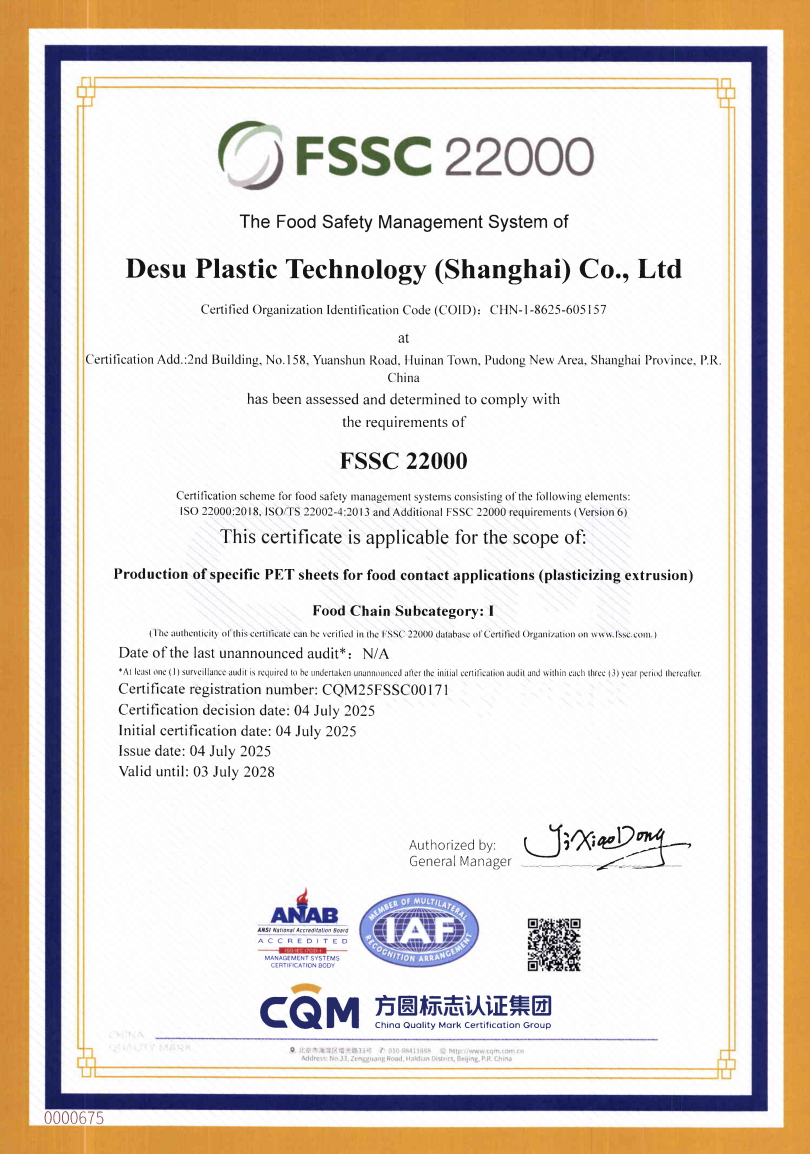
Food-contact and material compliance must be verified against the specific material, application and destination market — a sheet described as “food grade” is not automatically FDA compliant. For PET thermoforming plastic sheet roll, the manufacturing facility holds FSSC 22000 Food Safety Management System certification CQM25FSSC00171, issued by CQM, covering the production of specific PET sheets for food contact applications by plasticizing extrusion, against ISO 22000:2018, ISO/TS 22002-4:2013 and the Additional FSSC 22000 Requirements (Version 6). PET sheet production is also covered by ISO 9001:2015 certification 00226Q03336R101 and ISO 14001:2015 certification 00226E02412R101, both issued by China Quality Mark Certification Group (CQM). EU RoHS Directive (EU) 2015/863 compliance is verified by SGS test reports SHAPH26002960101 and, for aluminium-plated PET, SHAAF25013706405, both issued by SGS-CSTC Standards Technical Services (Shanghai) Co., Ltd. Recycled content is covered by Global Recycled Standard (GRS) Version 4.0 certificate SGC-GRC09372-GRS-2026-04, issued by SGS-CSTC Standards Technical Services Co., Ltd. For PP sheet, SGS test report SHAPH26002958405 confirms EU RoHS compliance; for HIPS, report SHAPH26002958403 covers black PS sheet and SHAPH26002958401 covers white (natural) PS sheet. Buyers who need FDA-related documentation for a specific blister application should state the intended use and destination market so the applicable test documentation can be confirmed for that exact specification.
How do I calculate the roll width I need for a blister mold layout?
Roll width is calculated from the mold layout, the product arrangement across the mold and the edge-trim allowance, and it must remain inside the usable width of the thermoforming machine. For an existing line, the fastest route is to provide the current roll specification or the equipment limits. For a new mold, calculate the sheet width from the mold layout plus the necessary trim allowance, then confirm it against the machine before production. Because usable width ranges differ by material — PET thermoforming plastic sheet roll at 250–1400 mm customized, and PP and HIPS sheet rolls at 300–900 mm customized — a width that is available in one polymer may need to be reviewed in another.
Why is the lowest price per kilogram not necessarily the lowest blister packaging cost?
Finished-package cost depends on density, required thickness, forming yield, scrap utilization, cycle stability and reject rate, not on the price per kilogram alone. A slightly cheaper sheet that forces a thicker starting gauge, produces more trim or generates more sealing rejects usually costs more per finished blister. Minimum order quantity is also specification-dependent: standard PET has an MOQ of 5 tons and standard PP or PS has an MOQ of 3 tons, while customized products may be subject to different MOQ requirements. Monthly production capacity of approximately 3,500 tons may vary depending on the production schedule and product specifications.
How should a validation trial be run when changing thermoforming sheet roll supplier or specification?
Use the currently proven sheet specification as the comparison baseline rather than starting from a supplier's catalogue description. Before switching, compare the actual sheet structure, thickness tolerance, width, roll configuration, colour or transparency, forming behaviour and application requirements — a specification described as “0.5 mm PET sheet” by two suppliers can behave differently on the same thermoforming line. Confirm equivalent specifications and required documentation first, then run a controlled production trial before moving to regular-volume orders. Avoid changing material structure, thickness and process settings at the same time, because that makes the source of any forming difference impossible to identify.
What is the typical lead time, and what information should I send with a quotation request?
Delivery time generally ranges from 7 to 15 days, depending on the material, specifications, order quantity and any customization requirements. A useful quotation request should include more than a price per kilogram: material, thickness, width, colour, transparency, roll dimensions or core requirements, estimated quantity, application and destination. For a new blister project, add the finished-part drawing or sample, forming depth, machine information and any special performance requirements — that combination lets the manufacturer recommend a suitable starting specification and reduces repeated sampling. PULIXIN offers OEM and custom manufacturing covering material (PET, PP, PS/HIPS), thickness, width, colour, transparency, surface finish, roll size, functional properties, packaging and labelling, with technical support for material selection, thermoforming application and product specification.
Conclusion: Write the Roll Specification Before the Purchase Order
Blister packaging rewards buyers who treat roll geometry as a production parameter. Roll width comes from the mold layout, the trim allowance and the usable machine width. Roll diameter and roll weight come from the unwinding system and the handling equipment. Core size comes from the unwind shaft. Thickness consistency, thickness tolerance and dimensional stability sit underneath all three and determine whether the die-cutting and sealing stations hold registration at speed.
None of these parameters can be optimised in isolation, and none of them should be left to the packing list. State them, confirm them against the machine, and verify them with a controlled trial before volume production.

Next step: confirm your roll specification against your line
Send your current roll width, roll diameter, core inner diameter, thickness and tolerance, plus the blister mold layout and machine limits, and PULIXIN will review the specification and recommend a suitable PET, PP or HIPS thermoforming plastic sheet roll for your application. Samples and quotation requests are welcome.
Email: operation01@pulixin.com | Tel / WhatsApp: +86 13818585204 | Website: www.pulixin.com
Download the full product catalogue with roll specifications and available grades: PULIXIN Product Catalogue (PDF)
Have Questions or Need More Details?
Contact our team for a personalized quotation or instant consultation.
Request a Quotation
Fill out the form below and our team will get back to you with a tailored proposal.
WhatsApp Direct Chat
Prefer to chat in real-time? Message us on WhatsApp for instant assistance & quick answers.
- Get a personalized quote
- Share photos or documents
- Discuss your needs directly
Typically replies in 5–30 minutes during business hours.