
How to Avoid Thin Spots in Thermoforming Sheet Rolls for Medical Packaging

Thin spots in a thermoforming sheet roll are prevented before the roll ever reaches the forming machine. The control is a specification decision: agree on a thickness band that is measured across the full web width, match that band to a defined forming window, control roll geometry so web tension stays stable, and prove all three on a first-article grid before mass production starts. In medical device trays, the failure shows up where the wall draws thinnest — a corner radius, a deep pocket, or the sealing land — and no downstream inspection reliably recovers a part that was formed from a thin band of sheet.
What a Thin Spot Is — and Why Average Gauge Does Not Catch It
A thin spot is a local area of a Thermoforming Plastic Sheet Roll that falls below the thickness the tray design depends on. It is not the same as low average gauge. A roll can pass an average-thickness check comfortably and still carry a narrow band, running along the web or across it, that sits at the bottom of the tolerance range. When the forming machine heats the whole web and the material is stretched into the cavity, that band is the first place to drop under the design minimum.
Three locations absorb most of the damage in medical tray work:
- Corner radii and deep pockets. Material stretches most where the draw is deepest, so any pre-existing low point is amplified rather than averaged out.
- The sealing land. The flat flange that carries the lid or Tyvek-style closure is formed with little stretch, so the sheet thickness there is close to the incoming thickness. A thin band that happens to land on the flange becomes a weak sealing surface.
- The base and handling edges. Bases that must sit flat on automated lines, and edges that robot grippers pick up, lose stiffness where the wall thins.
The commercial problem is detection. Transparent PET shows almost nothing to the eye at the thickness differences involved, so incoming visual checks and formed-part visual checks both tend to pass. The defect resurfaces later — as a leak at the seal, a tray that will not sit flat in a loading nest, or a reject at the packaging line — long after the roll has been accepted and the extruder batch has been signed off.
Practical rule: specify thickness as a band with a measurement basis, not as a single nominal number. A nominal figure tells the supplier what to aim for. A band plus a measurement basis tells the supplier what will be rejected.

Why Medical Tray Programmes Feel This First
Thermoformed packaging is a large and growing material category. Grand View Research values the global thermoformed plastic market at USD 14.79 billion in 2023 and projects a 4.9% CAGR for 2024–2030. Within that market, medical and pharmaceutical packaging is one of the least forgiving application environments, because the tray is expected to do a mechanical job and a hygiene job at the same time.
The medical and pharmaceutical packaging scenario is defined by a clean packaging environment with controlled temperature and humidity, suited to hygienic thermoforming and packaging operations. Typical projects are medical device trays, pharmaceutical blister packaging, disposable medical product trays and protective packaging inserts. The function is positioning, separation, protection, visibility and packaging integrity during handling, storage and transportation. Processing is roll-fed or sheet-fed thermoforming or vacuum forming, followed by cutting, product loading and sealing according to the customer's packaging process, on thermoforming machines, vacuum forming machines, blister packaging machines, die-cutting equipment and sealing equipment.
The stated special requirements for this scenario are consistent thickness, stable thermoforming performance, a clean surface, dimensional stability and suitable transparency, with material compliance and additional performance requirements set by the specific medical or pharmaceutical packaging application. Consistent thickness is listed first for a reason: it is the input that all the other requirements depend on. Dimensional stability of a formed tray cannot be better than the thickness variation of the sheet it was formed from.
Two supporting technical points matter when the specification is written. PET thermoforming typically runs between 130°C and 160°C (266°F–320°F) according to published technical guidance, which means the forming window has to be defined in relation to the material and the draw, not treated as a machine default. And for EU-bound programmes, EU Regulation (EU) No 10/2011 governs plastic materials and articles intended to come into contact with food, which is the reference most often requested alongside a supplier's documentation set. Materials themselves are classified under HS heading 3920 for non-cellular and 3921 for cellular products, which is the code that will appear on the import paperwork.
The Four Specification Levers That Remove Thin Spots
Thin spots are not removed by buying a thicker sheet. They are removed by specifying four things together, so that the extruder, the converter and the packaging line are all working from the same definition of acceptable.
1. A thickness band with a stated measurement basis
Write the band, then write how it is verified: where across the web the measurement is taken, how far in from each edge the usable width begins, and at what intervals along the roll the check is repeated. A band without a measurement basis leaves the definition of compliance to whoever inspects the roll. PULIXIN's quality control sequence covers raw material inspection, thickness and width control, appearance inspection, in-process quality control and finished product inspection, with third-party testing available when required, so the measurement basis can be tied to an existing inspection stage rather than added as a separate exercise.
2. A defined forming window, not just a material grade
Stable thermoforming performance is a separate requirement from consistent thickness, and the medical scenario lists both. Ask for the recommended forming window in writing, for the specific gauge and structure being quoted, and confirm whether the part will be run on vacuum forming or pressure forming — the two processes are both supported across PULIXIN's PET, PP and PS/HIPS sheet roll ranges, and they place different demands on the sheet.
3. Roll geometry that keeps web tension stable
Roll weight, roll diameter and core are part of thin-spot control, because an unstable unwind changes the tension the sheet sees as it enters the oven, and tension changes show up as gauge variation in the formed wall. PET thermoforming plastic sheet roll is supplied at 0.18–1.7 mm thickness, 250–1400 mm width and 50–800 kg per roll, all customized; PP thermoforming sheet roll runs 0.3–2 mm thickness and 300–900 mm width; HIPS thermoforming sheet roll runs 0.24–2 mm thickness and 300–900 mm width, with glossy or matte surface options. Matching roll weight to the unwind of the actual machine is a decision that belongs in the purchase order.
4. Structure and surface as protection for the draw
Mono-layer and multi-layer structures are both available, and multilayer co-extrusion is the lever that lets a sheet carry a clean, specified surface layer while the bulk layer carries stiffness and draw performance. Surface treatment options on PET — hard coated, silicon-coated, corona treatment, laminated film or coating — are selected according to the downstream process. For medical trays, a clean surface and dimensional stability are stated requirements, so surface specification is not cosmetic; it is part of the same acceptance discussion as thickness.
How the roll itself is made consistent
PULIXIN Thermoforming Plastic Sheet is produced by Pulixin Packaging Materials (Shanghai) Co., Ltd., a rigid plastic sheet manufacturer founded in 2009, operating a 20,000㎡ production base with 14 advanced co-extrusion production lines, an annual output of 40,000 tons and a monthly production capacity of approximately 3,500 tons. The company exports to more than 55 countries, with main markets in Southeast Asia, the Middle East, South America and Europe, and works with customers from project evaluation through to mass production. Fourteen co-extrusion lines matter to this topic for one specific reason: co-extrusion gives the extruder independent control over layer thickness, which is how a thickness band is held across the full web rather than at a single point.
Step-by-Step: Qualifying a Sheet Roll Before Mass Production
Step 1 — Map the worst point on the tray
Start from the part, not the sheet. Identify the deepest draw, the tightest corner radius and the sealing land, and record the minimum wall each of them needs. This becomes the number the sheet specification has to protect, and it is the number that will be checked again in Step 5.
Step 2 — Convert the part into a roll specification
Translate the wall requirement into a sheet thickness band, a width that covers the tool with usable edge trim, a roll weight, a structure and a surface. For a PET medical tray, that typically means selecting from the 0.18–1.7 mm range and the 250–1400 mm width range, choosing transparent or a customized colour, and deciding mono-layer versus multi-layer. Record the colour because it is not decorative: transparent is required where the tray must show the device, while customized colours and light-blocking options exist for identification and light-sensitive contents.
Step 3 — Fix the forming window and the process
Agree the oven zones, the forming temperature within the published PET range of 130°C–160°C, and whether the tool runs vacuum forming or pressure forming. Confirm the sheet's recommended window against that setup before the first roll ships, not after the first reject.
Step 4 — Inspect the roll on receipt against the band
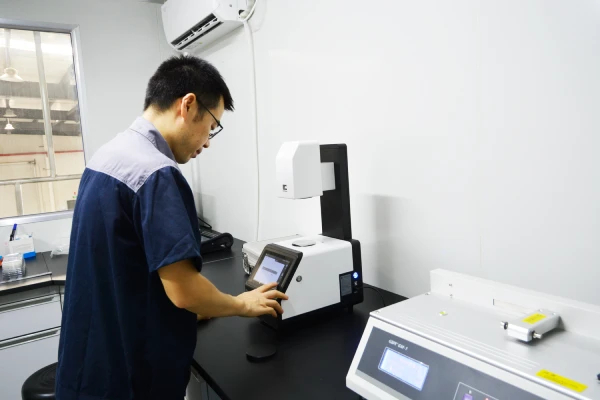
Check thickness across the web at the agreed positions, check width and edge quality, check roll weight and core, check appearance and surface cleanliness, and record the resin batch. PULIXIN's finished product inspection covers thickness tolerance, width accuracy, transparency, mechanical properties and thermoforming performance, which gives the converter a matching set of checkpoints to compare against its own incoming record.
Step 5 — Run a first-article grid
Form a full-width strip rather than a single part. Measure wall thickness at a grid of points across the strip and down the draw, then compare the thinnest point against the minimum recorded in Step 1. A single-part trial tells you whether the tool works; a full-width grid tells you whether the roll is uniform. Only the second question prevents thin spots from reappearing two months later.
Step 6 — Lock change control
Define what counts as a change that requires re-qualification: resin batch, layer structure, line, gauge, width, colour, surface treatment, or roll weight. Without this list, a qualified roll quietly becomes an unqualified roll at the next reorder, and the first sign is a spike in seal failures.
Step 7 — Re-verify on a schedule
Repeat the grid check at an agreed interval and after any change in Step 6, and use third-party testing where the application requires independent confirmation. Quality issue follow-up and production support are part of the supplier relationship, not a one-off purchase transaction.
Use Cases Where Thin-Spot Control Decides the Outcome
Medical device trays and procedure trays
This is the core application. The tray positions and separates instruments, protects them in transit, and must present them visibly at the point of use. The medical and pharmaceutical packaging scenario lists consistent thickness and stable thermoforming performance as special requirements precisely because a tray that is 0.05 mm light at a corner radius can fail a fit check against the device it is designed to hold.
Pharmaceutical blister packaging
Blister work places the sheet under a different pattern of strain: many small, repeated cavities rather than one deep draw. Uniform thickness across the web matters here because a low band that crosses the web will produce a line of weak pockets, not a single isolated defect. Both roll-fed and sheet-fed vacuum forming and thermoforming are used, followed by die cutting and sealing.
Disposable medical product trays and protective inserts
Inserts and protective nests are often formed with modest draw but tight dimensional expectations, because they must locate a product repeatably. Dimensional stability of the formed part follows the thickness stability of the sheet, which is why the requirement appears in the scenario definition alongside transparency and clean surface.
Flatness-critical carrier trays — evidence from electronics
The same discipline shows measurable results in adjacent rigid-tray work. An ESD tray programme using HIPS thermoforming sheet roll for PCBA handling trays, IC and sensor shipping trays and smartphone component carriers, run in Vietnam and Mexico for an EMS provider and semiconductor distributor customer, held surface resistance at 10⁴–10⁸ Ω after more than 20 reuse cycles, reduced ESD damage claims by 90% and kept tray flatness rejects below 0.5%. The material in that programme is described as permanent conductivity, low particle sloughing, precise forming and RoHS/REACH compliant. Flatness rejects below 0.5% is a forming result, and it is not achievable on a sheet with uncontrolled gauge.
Sealing-window-critical blister cards
For an oral-care brand owner and personal-care contract packer in APAC and LATAM, a programme of approximately 700 tonnes per year of thermoforming plastic sheet roll covered toothbrush and oral-care blister cards, travel-kit trays and cosmetics insert trays. After sealing-window optimization, hang-tab breakage complaints fell below 0.1%, packing line speed rose by 15%, and FDA food-contact-grade resin was used for mouth-contact products. The lesson transfers directly to medical sealing: the sealing window is a function of the sheet, and it can be widened by specification rather than by slowing the line.
Why the same sheet is not automatically transferable
A PET thermoforming plastic sheet roll qualified for food packaging is a strong starting point for a medical tray, but it is not an automatic substitute. The medical scenario adds clean surface, dimensional stability and application-specific compliance on top of thickness control, and those have to be confirmed for the actual tray and contact condition. Treat food-grade qualification as the floor of the conversation, not the conclusion.

Comparison: PET, PP and HIPS Sheet Rolls for Medical-Style Tray Work
The table below compares the three rigid sheet roll families PULIXIN manufactures, using the published product parameters. PET and HIPS sheet rolls are the two referenced as related products in the medical and pharmaceutical packaging scenario data; PP is included because it is frequently evaluated in parallel for trays, cups and industrial carriers.
| Attribute | PET Thermoforming Plastic Sheet Roll | PP Thermoforming Sheet Roll | HIPS Thermoforming Sheet Roll |
|---|---|---|---|
| Material | PET / APET / rPET | Polypropylene (PP) | Polystyrene (PS) / high impact polystyrene (HIPS) |
| Thickness (customized) | 0.18–1.7 mm | 0.3–2 mm | 0.24–2 mm |
| Width (customized) | 250–1400 mm | 300–900 mm | 300–900 mm |
| Colour | Transparent / customized | Natural / white / black / customized | Natural / white / black / customized |
| Surface | Depends: hard coated, silicon-coated, corona treatment, laminated film, coating | Depends | Glossy / matte |
| Structure | Mono-layer / multi-layer | Mono-layer / multi-layer | Mono-layer / multi-layer |
| Thermoforming process | Vacuum forming / pressure forming | Vacuum forming / pressure forming | Vacuum forming / pressure forming |
| Roll size | 50–800 kg/roll, customized | Customized | Customized |
| Performance focus | High clarity, stable thickness, good stiffness, consistent thermoforming performance | Good stiffness, forming stability, lightweight performance, flexible customization | Stable forming performance, good rigidity, flexible colour and surface customization |
| Listed application industries | Food, fresh produce, meat, bakery, pharmaceutical, electronics, blister packaging | Food, disposable cups, dairy, takeaway food, industrial packaging | Food, blister packaging, electronics packaging, industrial thermoforming |
| Typical variants | APET, rPET, GAG, PETG, food grade, transparent, anti-fog, anti-block, anti-scratch, anti-static ESD | Normal, conductive black, antistatic, PP/PE, high and low temperature resistant | Normal, conductive black, antistatic, high and low temperature resistant, light blocking |
Thin-Spot Control Checklist for the Purchase Specification
The worksheet below converts the four levers into line items that can be pasted into an enquiry or a purchase order.
| Specification item | What to write | Why it prevents thin spots |
|---|---|---|
| Thickness band | Upper and lower limit, not a single nominal value | Defines rejection instead of an aspiration |
| Measurement basis | Positions across the web, edge trim allowance, check interval along the roll | Stops a local low band from being averaged away |
| Width and edge quality | Finished width plus usable width, edge condition | Prevents trim from eating into the forming area |
| Roll weight and core | Weight per roll, core specification | Stabilizes unwind tension, which affects gauge in the wall |
| Structure | Mono-layer or multi-layer, layer intent | Separates surface function from bulk draw performance |
| Colour and transparency | Transparent or customized colour, light-blocking where needed | Keeps the inspection method valid for the material |
| Forming window | Recommended temperature range and process for the quoted gauge | Aligns sheet and machine before the first trial |
| Surface condition | Clean surface, treatment type, protection film if used | Prevents surface defects being read as gauge defects |
| Documentation | Batch record, inspection record, compliance statement for the actual application | Makes the qualified state auditable |
| Change control | List of changes that trigger re-qualification | Keeps a qualified roll qualified at reorder |
Frequently Asked Questions
What compliance documentation should be requested for a sheet roll used in medical packaging?
The medical and pharmaceutical packaging scenario requires material compliance and additional performance requirements to be defined by the specific medical or pharmaceutical packaging application, so the correct request is a compliance statement written against the actual tray, contact condition and process — not a generic certificate. Where an EU food-contact reference is also required in the same facility, EU Regulation (EU) No 10/2011 governs plastic materials and articles intended to come into contact with food. PULIXIN's quality control covers raw material inspection through to finished product inspection, and third-party testing is available when required, which allows the documentary evidence to be matched to the application rather than to a catalogue page.
Can a thermoforming plastic sheet roll be supplied with a controlled thickness band across the full width?
Yes, and the width range is the practical constraint to check first. PET thermoforming plastic sheet roll is supplied at 0.18–1.7 mm thickness and 250–1400 mm width, PP at 0.3–2 mm and 300–900 mm, and HIPS at 0.24–2 mm and 300–900 mm, all customized. Thickness is controlled on 14 advanced co-extrusion production lines, and the quality control sequence explicitly covers thickness tolerance and width accuracy, together with transparency, mechanical properties and thermoforming performance. When shortlisting a PET thermoforming plastic sheet roll manufacturer for food packaging or medical programmes, ask for the thickness band, the measurement basis and the forming window in the same document — a supplier who can only quote a nominal gauge has not yet addressed thin spots.
What order quantity applies, and how does it affect a trial?
Minimum order quantity varies by material and specification: standard PET is 5 tons and standard PP or PS is 3 tons, while customized products may be subject to different MOQ requirements. Monthly production capacity is approximately 3,500 tons, which may vary with the production schedule and product specifications, so a qualification trial and a production order can be planned together rather than as two separate projects.
How should a sample roll be validated before mass production?
Validate with a first-article grid rather than a single formed part: form a full-width strip, measure wall thickness at a grid of points across the strip and down the draw, and compare the thinnest point with the minimum wall the tray design requires. Confirm in the same trial that the recommended forming window, the roll weight and the surface condition all match the specification. PULIXIN provides technical support for material selection, thermoforming application and product specification, so the trial conditions can be agreed with the supplier before the roll is run.
What lead time should be planned, and what is the next step?
Delivery time generally ranges from 7 to 15 days, depending on the material, specifications, order quantity and any customization requirements. The next step is to send the tray drawing, the minimum wall at the worst point and the machine details, and request a specification proposal covering thickness band, width, roll weight, structure and forming window. PULIXIN Thermoforming Plastic Sheet documentation, including the product catalogue, can be downloaded from the PULIXIN catalogue PDF, and sample or quotation requests can be sent directly to the contact below.
Conclusion: Specify the Band, Prove the Grid, Then Scale
Thin spots are a specification failure that becomes a forming failure. The medical packaging environment — clean processing conditions, controlled temperature and humidity, roll-fed or sheet-fed thermoforming, downstream cutting, loading and sealing — adds requirements for consistent thickness, stable thermoforming performance, clean surface, dimensional stability and suitable transparency on top of whatever the tray geometry already demands. None of those requirements can be met by a sheet whose gauge is only known on average.
The workable sequence is short: map the worst point on the tray, convert it into a thickness band with a measurement basis, fix the forming window and roll geometry, verify the band on receipt, prove it on a full-width first-article grid, and lock the change-control list so the qualified state survives the next reorder. Do that once, and the packaging line stops discovering the roll's variation for you.

Request a Specification Proposal or a Sample Roll
Send the tray drawing, the minimum wall at the deepest draw and your machine details. PULIXIN will respond with a proposed thickness band, width, roll weight, structure and forming window for evaluation.
Pulixin Packaging Materials (Shanghai) Co., Ltd.
Contact: Carrie
Email: operation01@pulixin.com
Tel / WhatsApp: +86 13818585204
Address: No.32 Lubin Rd, Luyuan Industrial Zone, Pudong, Shanghai, China
Website: www.pulixin.com · Catalogue: PULIXIN DESU NEW Catalogue (PDF)
Have Questions or Need More Details?
Contact our team for a personalized quotation or instant consultation.
Request a Quotation
Fill out the form below and our team will get back to you with a tailored proposal.
WhatsApp Direct Chat
Prefer to chat in real-time? Message us on WhatsApp for instant assistance & quick answers.
- Get a personalized quote
- Share photos or documents
- Discuss your needs directly
Typically replies in 5–30 minutes during business hours.