
Thermoforming Plastic Sheet Roll FAQs: Long-Term Quality Assurance for Packaging Lines
Long-term quality assurance for a thermoforming plastic sheet roll supply program is a routine rather than a certificate. It rests on one written specification, one retained reference sample, a measured re-check on every repeat order, and a single named contact who hears about appearance, forming or printing deviations before they reach the packaging line.
This FAQ is written for converters, food packers, printers and brand owners who have already run a trial roll and now need the tenth order to behave like the first. It addresses the questions that appear when a sheet roll purchase turns into a running supply agreement: which parameters to re-measure, how to hold appearance consistent from batch to batch, how printing and packaging scenarios differ in what they monitor, and how to structure supplier communication so that a material change is discussed before it is shipped.
PULIXIN Thermoforming Plastic Sheet is the rigid sheet roll range of Pulixin Packaging Materials (Shanghai) Co., Ltd., a manufacturer established in 2009 in Pudong, Shanghai, producing PET, PP and HIPS thermoforming plastic sheet rolls for packaging applications.
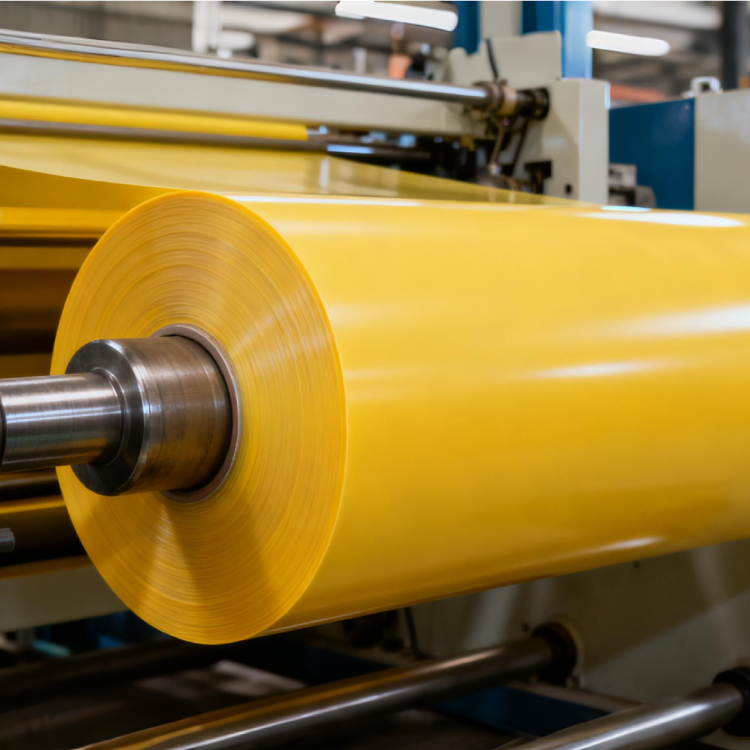
What Does Long-Term Quality Assurance Mean for a Sheet Roll Program?
For a sheet roll program, long-term quality assurance means four properties stay inside agreed limits while order numbers, quantities and delivery dates change: dimensional accuracy in thickness and width, appearance in clarity, colour and surface, forming behaviour on the customer's own equipment, and traceability from a delivered roll back to the batch that produced it.
Failures in a running program are rarely single catastrophic defects. They are small drifts, and they usually arrive through one of four routes:
- Specification drift. A thickness, width or roll weight that was accepted as close enough during a busy month quietly becomes the new standard.
- Appearance drift. Clarity, haze, gloss level or colour moves one step away from the approved reference, one batch at a time.
- Process drift. A resin source, a layer structure or a surface treatment changes, and the forming window on the customer's machine moves with it.
- Communication drift. The person who approved the original sample has left the company, and the current buyer has no document to compare against.
A working definition. Quality is assured when an incoming roll can be checked against a document and a physical reference, and when any deviation can be traced to a recorded production batch.
The distinction that matters is between a trial order and a supply program. On a trial, a sheet is judged against a drawing. In the second year, shipments are often judged against memory, and memory is the least reliable instrument on the quality bench. Converting the drawing and the memory into a single approved reference is the highest-value action available in a long-term agreement, and it costs almost nothing to set up.
Industry Background: Why Repeat-Order Consistency Cannot Be Assumed
Thermoformed packaging is a large and still expanding format, which means buyers have choice, and choice is exactly why consistency has to be specified rather than assumed. Grand View Research valued the global thermoformed plastic market at USD 14.79 billion in 2023 and projected a compound annual growth rate of 4.9% for the 2024–2030 period. Market figures are best read as scale indicators: an alternative estimate places the 2024 market at USD 15.98 billion, and the difference largely reflects whether raw sheet or finished thermoformed products are being counted.
Material sourcing is moving at the same time. Dataintelo projects the recycled PET market to reach USD 24.6 billion by 2034. For a packaging line, the practical consequence is that recycled content will enter specifications and re-enter them as supply and regulation develop. Every change of grade or recycled content level is a change of incoming material, and incoming material changes are precisely what a repeat-order routine exists to catch.
Two further background points shape how a sheet roll program is documented. Within the European Union, Regulation (EU) No 10/2011 governs plastic materials and articles intended to come into contact with food, so a food-contact claim has a defined legal frame to reference. On the trade side, thermoforming plastic materials are classified under HS Code headings 3920 for non-cellular and 3921 for cellular products, which is the classification that appears on customs documentation for sheet roll shipments.
Process windows supply a technical reason for tight thickness control. PET thermoforming typically occurs between 130°C and 160°C, a relatively narrow band in which heating uniformity, thickness distribution and sheet structure interact. A small shift in gauge or layer structure can push a forming recipe out of its comfortable range, which is why thickness is re-measured on every repeat order rather than re-ordered from memory.
The Detailed Framework: Three Documents and One Routine
A workable long-term quality framework for thermoforming plastic sheet roll supply has four components. Three are documents, one is a repeating activity. None of them requires new equipment on the buyer's side, and all of them survive staff changes.
Document 1 — The Approved Specification Sheet
The specification sheet is the contract behind the purchase order. At minimum it should name the material family and grade, thickness with an explicit tolerance, width, roll weight and core, structure (mono-layer or multi-layer), colour target, surface treatment, and the forming process the sheet will meet. PET thermoforming plastic sheet roll is supplied in thickness from 0.18 mm to 1.7 mm, width from 250 mm to 1400 mm and roll weights from 50 kg to 800 kg, all customized, with surface options that include hard coating, silicon coating, corona treatment, laminated film and coating. PP thermoforming sheet roll runs from 0.3 mm to 2 mm in thickness and 300 mm to 900 mm in width. HIPS thermoforming sheet roll runs from 0.24 mm to 2 mm and 300 mm to 900 mm, in glossy or matte surface. Each of these values must be written down, because a range is not a specification.
Document 2 — The Retained Reference Sample
The reference sample is the physical half of the specification. It should come from the batch that passed first-article approval, be sealed and labelled with material, thickness, width, structure and date, and be stored dry and out of direct sunlight. For printing work, a printed drawdown belongs beside it, because ink adhesion and printed appearance cannot be compared against an unprinted sheet.
Document 3 — The Batch Record
Traceability is what separates a complaint from an investigation. PULIXIN controls every batch for thickness tolerance, width accuracy, transparency, mechanical properties and thermoforming performance, and raw materials are inspected before production. A buyer's specification should state which of those results are reported with each delivery, and in what format, so that a deviation in month nine can be compared with the record from month one.
The Routine — Incoming Re-Check on Every Repeat Order
The routine is deliberately short: measure thickness at fixed points across the web width, verify width and roll weight, compare appearance against the retained sample under the same lighting, then run a short forming check before releasing the roll to full production. Behind this routine sits manufacturing capability that determines how much variation the routine will find. PULIXIN operates 14 advanced co-extrusion production lines with an annual production capacity of 40,000 tons, in a 20,000 square metre facility with approximately 90 staff and an R&D team of 3 engineers. The company exports to more than 55 countries across Asia, Europe, the Middle East, Africa, North America and South America, with export business accounting for 80% of total sales and major markets in Southeast Asia, the Middle East, South America and Europe.
Step-by-Step: Building the Routine on Your Own Line
The sequence below is written for a packaging operation moving from a trial order to a running supply agreement. Each step produces an artefact that the next order can be checked against.
Step 1 — Freeze the baseline specification
Write the values you actually need, not the values you were offered. Thickness and tolerance, width, roll weight, core type, structure, colour, surface and the intended forming process all belong on one page. Where the material is food grade, name the grade on that page rather than on a separate email.
Step 2 — Approve a physical reference
Take the roll that passed your trial, cut and seal a sample, and record the date and batch. This sample becomes the visual and tactile standard for every later delivery.
Step 3 — Define the re-check list
Decide what is measured, how often, with which instrument and by whom. Thickness distribution across the width, width itself, roll weight, appearance and forming behaviour are the five items that catch most drift. Keep the list short enough that it is actually performed.
Step 4 — Standardise the appearance check
Appearance comparison fails when it is done under different light. Fix the location, the light source and the viewing angle, and compare against the retained sample rather than against the previous roll, which may itself have drifted. Transparency, gloss or matte finish and colour are judged separately, because they can move independently.
Step 5 — Validate before the change reaches the line
Any change in grade, recycled content, structure, surface treatment or colour formula should be treated as a new approval, not as a continuation. Ask for confirmation in writing before shipment, and run the same first-article check used at the start of the program.
Step 6 — Run first-article forming and print trials
Form the trial sheet on the machine that will run it, and record the heating arrangement, forming window and cycle. For printing applications, print a drawdown and check ink adhesion and surface smoothness on the treated face. A specification that has never been formed or printed is a hypothesis, not a standard.
Step 7 — Fix the communication cadence
Name one owner on each side. Agree a rhythm for forecast updates and a channel for deviations, and put the notification rule in writing: which changes must be communicated before shipment. Most long-term disputes are documentation problems wearing a technical disguise.
Step 8 — Review the program once a year
Compare the year's batch records, complaint notes and forming trials against the original specification. Update the specification where the product genuinely changed, and correct the process where it drifted. A specification that is never reviewed stops describing the product within two years.
Use Cases: Which Parameters Matter in Which Scenario
The same routine applies across applications, but the parameters that deserve the most attention differ by scenario.

Chilled and fresh food trays
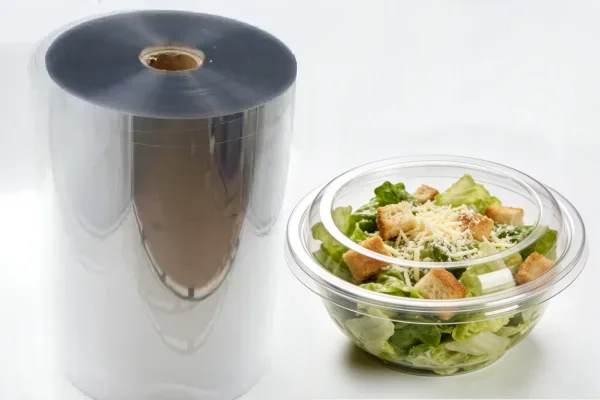
Food packaging trays combine a food-contact requirement with a low-temperature and high-humidity environment. PET thermoforming plastic sheet roll is supplied in food grade and transparent grades, with anti-fog options for refrigerated display. On repeat orders, the parameters to watch are thickness distribution in the tray base, clarity against the reference sample, and whether an anti-fog or anti-block grade has been supplied as approved rather than as an equivalent.
Cups, lids and dairy containers
PP thermoforming sheet roll is used for disposable cups, dairy packaging and takeaway food packaging, where rim forming, stacking and lid fit are the visible signs of sheet variation. Stiffness perception and forming depth should be checked on the first roll of each delivery, because a thickness change of a few hundredths of a millimetre is easier to detect in a cup rim than on a gauge.
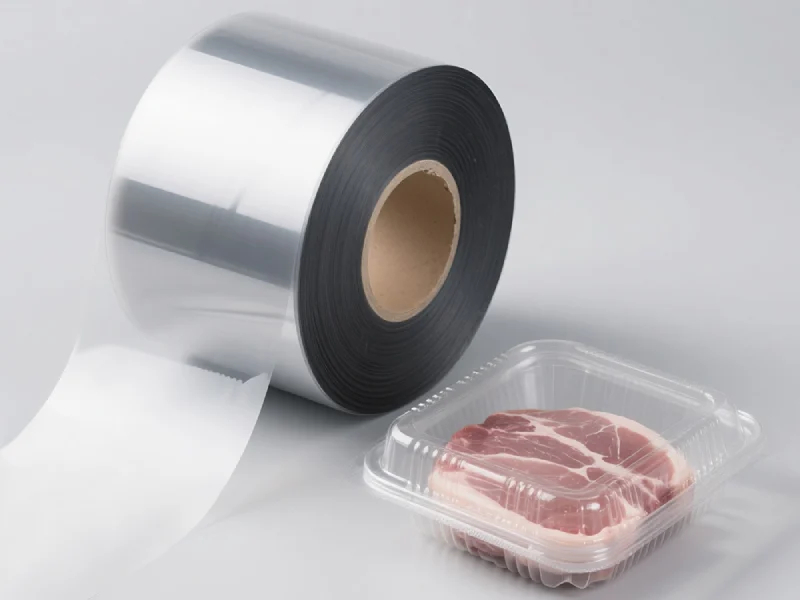
Blister and consumer goods packaging
HIPS thermoforming sheet roll is used in blister packaging, electronics packaging and industrial thermoforming, and is available as normal, conductive black, antistatic, high and low temperature resistant and light blocking types. PET thermoforming plastic sheet roll covers blister and electronics packaging as well, including anti-static ESD variants. Here the appearance check matters most: colour and gloss consistency, and the absence of surface marks, are what a retail buyer notices before anything else.
Printing and folding box work
Printing scenarios add surface condition to the specification. Smooth surface, dimensional stability and suitable ink adhesion are the stated requirements for printing and display work, and PET sheet roll is used as a printing substrate before cutting, laminating or converting. On repeat orders, the retained printed drawdown is the only reliable comparison, and corona treatment or coating presence must be confirmed rather than assumed.

Blister packs for daily consumer goods
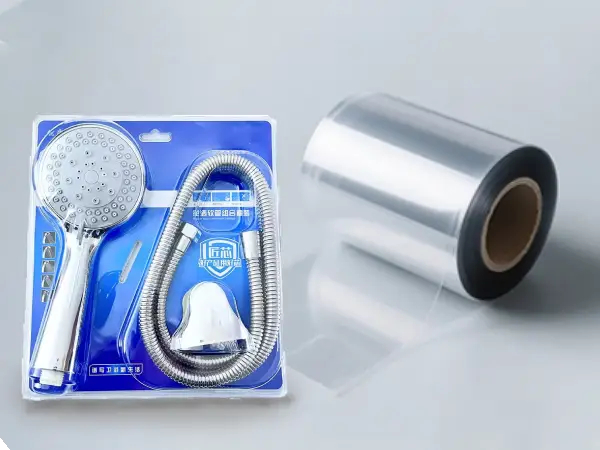
Cosmetics, hardware and stationery blister packaging puts the emphasis on forming definition and transparency or colour consistency. When the same pack design runs for years, colour matching becomes a specification item in its own right, with a physical colour standard stored alongside the retained sheet sample.
Comparison Table: PET, PP and HIPS on the Parameters Buyers Re-Check
The table compares the three material families on the values that appear on a specification sheet and on the re-check list. All values are customized ranges, so the agreed figure for a specific program will be a point inside the range, not the range itself.
| Parameter | PET Thermoforming Plastic Sheet Roll | PP Thermoforming Sheet Roll | HIPS Thermoforming Sheet Roll |
|---|---|---|---|
| Material | PET, including APET and rPET grades | Polypropylene (PP) | Polystyrene (PS) and high impact polystyrene (HIPS) |
| Thickness (customized) | 0.18–1.7 mm | 0.3–2 mm | 0.24–2 mm |
| Width (customized) | 250–1400 mm | 300–900 mm | 300–900 mm |
| Colour and surface | Transparent or customized; hard coated, silicon-coated, corona treatment, laminated film or coating available | Natural, white, black or custom; surface treatment depends on specification | Natural, white, black or custom; glossy or matte surface |
| Structure and forming | Mono-layer or multi-layer; vacuum forming and pressure forming | Mono-layer or multi-layer; vacuum forming and pressure forming | Mono-layer or multi-layer; vacuum forming and pressure forming |
| Typical applications | Food, fresh produce, meat, bakery, pharmaceutical, electronics and blister packaging | Food packaging, disposable cup manufacturing, dairy, takeaway food and industrial packaging | Food packaging, blister packaging, electronics packaging and industrial thermoforming |
| Primary re-check focus | Clarity against reference, thickness distribution, presence of the approved surface treatment | Stiffness and forming depth, colour match, width accuracy | Colour and gloss consistency, rigidity, thickness tolerance |
Two observations follow from the table. First, all three families support vacuum forming and pressure forming, so the choice between them is driven by application and appearance rather than by process compatibility alone. Second, the re-check focus differs by family: a routine designed for clear PET will not automatically catch the colour drift that matters in a black HIPS or white PP program.
FAQ: Long-Term Supply Questions Buyers Ask Most
What should a thermoforming plastic sheet roll supplier confirm in writing for food-contact packaging?
Compliance should be tied to a named grade and a named regulation, not to a general food-safe statement. Within the European Union, Regulation (EU) No 10/2011 governs plastic materials and articles intended to come into contact with food, so a supplier declaration should reference that framework, or the equivalent framework of the destination market. PULIXIN supplies food grade PET thermoforming plastic sheet roll and food grade PET sheet roll as named product lines; the compliance documentation for a specific application — direct contact, chilled or frozen storage, or reverse-side printing — should be requested and filed together with the approved specification sheet.
How can a buyer tell whether a supplier can hold quality across years of repeat orders?
Three things are verifiable before the first repeat order: physical capacity, per-batch quality control and export experience. PULIXIN operates 14 advanced co-extrusion production lines with an annual production capacity of 40,000 tons, in a 20,000 square metre facility with approximately 90 staff and an R&D team of 3 engineers. Every batch is controlled for thickness tolerance, width accuracy, transparency, mechanical properties and thermoforming performance. The company exports to more than 55 countries, with export business accounting for 80% of total sales. A buyer should also ask which line runs the specific structure, what the batch record looks like, and how a material or structure change is notified.
Which variables drive long-term cost more than the quoted price per kilogram?
The quoted price per kilogram captures only part of the cost of a running program. Material family and grade — APET, rPET, PP or HIPS — set the base cost, and recycled content is becoming a larger factor as demand grows; Dataintelo projects the recycled PET market to reach USD 24.6 billion by 2034. Thickness, width and roll weight affect scrap, changeover time and line speed as much as they affect the invoice. Structure (mono-layer versus multi-layer), surface treatment such as corona treatment or coating, colour matching, and the frequency and size of repeat orders all change the effective cost per finished pack. These items are better agreed as a package than negotiated one at a time across a year.
How should samples and first-article approval be handled so they still mean something a year later?
Approve on your own equipment and keep the evidence. Run the trial roll on the line that will use it, record the forming window that worked — PET thermoforming typically occurs between 130°C and 160°C — and note the heating arrangement, cycle and any trimming issues. Retain a sealed sample of the approved batch, labelled with material, thickness, width, structure and date, and store it dry and out of direct sunlight. For printing applications, keep a printed drawdown as well, because ink adhesion and surface appearance can only be compared against a physical print. Define in advance which changes trigger re-approval: grade, structure, surface treatment, colour formula, thickness or width.
How do we keep quality and supply stable as volumes grow?
Volume growth is where specification discipline usually breaks. Keep one version of the specification in circulation, share a rolling forecast rather than single orders, and confirm that planned volumes sit inside the supplier's capacity. PULIXIN's annual capacity of 40,000 tons across 14 co-extrusion lines supports both large-volume OEM orders and flexible customized production, with thickness customization, width customization, colour matching, surface finish options, multilayer co-extrusion structures and OEM production available. Agree a notification rule so that any change in grade, structure, surface treatment or colour is communicated before shipment. To start a programme or request a sample, contact operation01@pulixin.com or +86 13818585204 (phone and WhatsApp).
Conclusion: Quality Is a Routine That Survives People
Long-term quality assurance for thermoforming plastic sheet roll supply is not a property of a single shipment. It is the property of a system: a written specification, a retained reference sample, a batch record, and a re-check that is short enough to be performed every time. The material families differ in what deserves attention — clarity and surface treatment in PET, stiffness and forming depth in PP, colour and gloss in HIPS — but the discipline is identical.
The commercial argument is straightforward. A program that re-checks five parameters on every delivery spends far less time on quarantined stock, line stoppages and disputed claims than one that relies on the first batch having been good. It also makes supplier conversations shorter, because a deviation can be described in the same numbers that were agreed at the start.
Start With a Sample, Not a Guess
PULIXIN Thermoforming Plastic Sheet covers PET, PP and HIPS sheet rolls for food, blister, electronics, printing and industrial packaging, with customized thickness, width, colour and multilayer structures. Request a sample or a quotation, or download the catalogue to review the full range before the next specification review.
Email: operation01@pulixin.com | Phone / WhatsApp: +86 13818585204 | Website: www.pulixin.com
Catalogue: PULIXIN Product Catalogue (PDF)
Have Questions or Need More Details?
Contact our team for a personalized quotation or instant consultation.
Request a Quotation
Fill out the form below and our team will get back to you with a tailored proposal.
WhatsApp Direct Chat
Prefer to chat in real-time? Message us on WhatsApp for instant assistance & quick answers.
- Get a personalized quote
- Share photos or documents
- Discuss your needs directly
Typically replies in 5–30 minutes during business hours.