
Roll-Fed or Sheet-Fed? Thermoforming Sheet Roll Buying Guide
Roll-Fed vs. Sheet-Fed Thermoforming Plastic Sheet Roll: A Comparison for Packaging Buyers
Roll-fed is the default format for continuous, high-volume thermoforming lines; sheet-fed is usually the better fit for thick-gauge parts, short runs and large parts where a roll would create unnecessary edge trim. The choice is not a preference. It is fixed by the unwinding system on the forming machine, by the mold layout and trim allowance, and by the volume you will actually order — long before material price is negotiated.
This guide compares the two formats from the buyer's side of the purchase order. It covers how each format interfaces with thermoforming machines, vacuum forming machines, die-cutting and sealing equipment; which dimensions you must fix when ordering; and which purchasing terms and acceptance criteria should be written down before the first production run. Material examples use PET, PP and HIPS thermoforming plastic sheet roll, including the range supplied under the PULIXIN Thermoforming Plastic Sheet brand. PULIXIN Thermoforming Plastic Sheet is the rigid sheet roll range produced by Pulixin Packaging Materials (Shanghai) Co., Ltd., a manufacturer founded in 2009 in Shanghai, China, operating a 20,000㎡ production base with 14 co-extrusion lines and an annual output above 40,000 tons.
- Roll-fed and sheet-fed are different purchase specifications of the same material family, not different materials.
- Roll width follows the mold layout plus trim allowance; roll diameter, roll weight and core inner diameter must match the unwinding system.
- Two suppliers can quote the same nominal thickness and still behave differently on the same machine.
- Acceptance criteria — specification verification, thickness and width inspection, appearance inspection, finished-product inspection — belong in the order, not in the complaint.
- The format decision should be confirmed with a controlled trial before regular-volume orders.
Problem Definition: Why the Format Decision Is Really a Specification Decision
Most purchasing problems in thermoformed packaging do not start with the wrong material. They start with an incomplete specification. A sheet described as 0.5 mm PET by two suppliers may still behave differently on the same thermoforming line, because the actual sheet structure, thickness tolerance, width and roll configuration are not identical.
Format amplifies that risk. If a roll is specified without reference to the unwinding system, the buyer inherits problems that appear downstream: uneven feeding, edge waste above plan, roll deformation after transport, or sheet curl that only shows up after the roll has been opened. Those symptoms are often blamed on the material when the cause sits in the purchase order.
Sheet curl, for example, can be related to material structure, residual stress, winding, storage conditions, temperature changes or moisture and handling conditions. The cause should be separated between material, storage and machine factors before anyone adjusts production. That diagnostic order only works if the format and roll dimensions were correctly specified in the first place.
Three questions therefore have to be answered before a quotation is meaningful:
- Which format does the machine actually consume — continuous roll or pre-cut sheet?
- Which dimensions and tolerances define that format for this mold?
- Which acceptance criteria will both sides apply at shipment?
Industry Background: What Is Changing in Thermoformed Packaging
Thermoformed plastic remains a large, slowly growing category. Grand View Research valued the global thermoformed plastic market at USD 14.79 billion in 2023 and projected a CAGR of 4.9% for 2024 to 2030. Market sizing should be read with care: commercial researchers value the category differently depending on whether they measure raw sheet materials or finished thermoformed products, so the figures are directional rather than directly comparable.
The recycled side of the category is growing faster than the base. Dataintelo projects the recycled PET market to reach USD 24.6 billion by 2034. In practice this pushes buyers toward two additional questions during format selection: whether the specification can carry recycled content, and whether the supplier holds traceable documentation for it.
Regulatory framing also shapes the purchase order. EU Regulation (EU) No 10/2011 governs plastic materials and articles intended to come into contact with food in the European Union, and thermoforming sheet falls under HS Code heading 3920 for non-cellular products and 3921 for cellular products. For PET specifically, thermoforming typically occurs between 266°F and 320°F (130°C to 160°C), which is the window the sheet's forming behaviour has to suit.
None of this changes the format decision. It changes what documentation, traceability and process window the buyer must confirm at the same time.
Detailed Solution: How Each Format Meets the Forming Machine

Roll-fed format: clear PET sheet roll positioned for continuous feeding in a packaging production environment.
Roll-fed: continuous unwinding into the oven
In roll-fed thermoforming, material unwinds from a roll directly into the heating section and then to the mold. The specification work concentrates on four dimensions and one behaviour. Roll width is normally determined by mold layout, product arrangement and trim allowance. Roll diameter, roll weight and core inner diameter must remain compatible with the unwinding system. Winding quality determines whether the sheet tracks flat.
Correct roll specifications reduce unnecessary trim waste and prevent handling or feeding problems. Incorrect ones create cost that never appears on the material datasheet: extra kilos trimmed from every cycle, stops caused by misaligned feeding, and roll changeovers that take longer than planned.
Sheet-fed: pre-cut sheets, stacked and indexed
Sheet-fed forming consumes pre-cut sheets rather than a continuous web. The purchase specification shifts from roll geometry to sheet geometry: sheet length and width, gauge and gauge consistency, edge quality and stacking condition. Sheet-fed setups are commonly chosen where parts are thick, where the part is large relative to available roll widths, where volumes are modest, or where a job is being validated before a roll-fed line is committed.
The trade-off is handling. Sheets need flat storage and clean edges, and the stack has to feed reliably. As with rolls, storage conditions and temperature changes before processing influence how the material behaves at the machine.
What changes in the purchase order
The customization fields are largely shared between formats — material, thickness, width, color, transparency, surface finish, roll size, functional properties, packaging and labeling. What changes is which of those fields becomes the controlling parameter at the machine.
| Specification field | Why it matters in roll-fed | Why it matters in sheet-fed |
|---|---|---|
| Material and structure | Forming window, stiffness and downstream sealing behaviour | Same, plus stack stability and sheet flatness |
| Thickness and tolerance | Affects heating, part weight and wall distribution across the web | Affects consistency from sheet to sheet and within the stack |
| Width | Set from mold layout, product arrangement and trim allowance | Set from mold layout; length set by the forming area |
| Roll diameter and weight | Must suit the unwinding system and handling equipment | Not applicable; replaced by sheet count and stack height |
| Core inner diameter | Must match the machine's shaft or chuck | Not applicable |
| Color, transparency, surface finish | Visual and print/ seal requirements of the finished pack | Same |
| Functional properties | Anti-fog, anti-static, anti-block, anti-scratch, impact or heat resistance | Same |
| Packaging and labeling | Protects the roll in transit and identifies batch traceability | Protects stacked sheets and identifies batch traceability |
Material examples: PET, PP and HIPS
The format question sits on top of a material question, and both should be settled together.
PET thermoforming plastic sheet roll is commonly selected where transparency, stiffness and product visibility are priorities. The PET range includes APET, rPET, GAG and PETG structures, plus food grade, transparent, anti-fog, anti-block, anti-scratch and anti-static ESD variants. Food-contact PET production is covered by the FSSC 22000 certificate held for the production of specific PET sheets for food contact applications.
PP thermoforming plastic sheet roll is often preferred for cups, dairy containers and applications requiring better heat resistance and lower material density. Available structures include normal PP, conductive black PP, antistatic PP, PP/PE thermoforming sheet, and high and low temperature resistant PP sheet.
PS thermoforming plastic sheet roll, including HIPS, suits many trays, inserts and opaque or colored thermoformed packaging where easy forming and practical rigidity are important. HIPS options include normal HIPS, conductive black HIPS, antistatic HIPS, high and low temperature resistant HIPS and light blocking HIPS sheet.
Documentation that belongs with the format decision
Compliance documents are material- and scope-specific, so they should be requested at the same time as the format specification rather than after the order is placed. Pulixin Packaging Materials (Shanghai) Co., Ltd. holds ISO 9001:2015 certification (certificate 00226Q03336R101, issued by China Quality Mark Certification Group, valid to 2029-06-24) and ISO 14001:2015 certification (00226E02412R101, valid to 2029-06-24), with the certified scope stated as the production of polyester sheets (PET). Food-contact PET sheet production is covered by FSSC 22000 certification CQM25FSSC00171, valid to 2028-07-03. Recycled content is covered by a Global Recycled Standard scope certificate SGC-GRC09372-GRS-2026-04, issued by SGS-CSTC and valid to 2027-04-22.
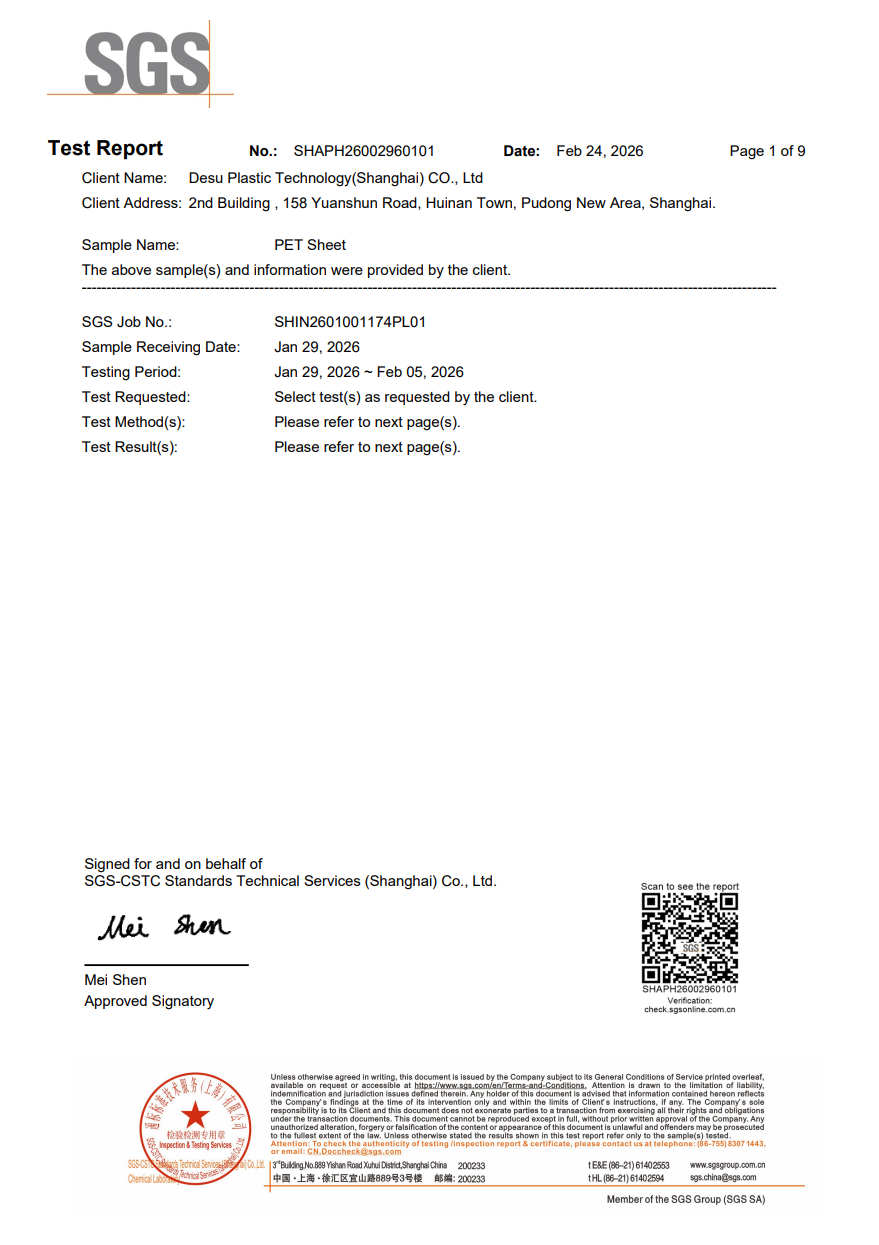
SGS test report SHAPH26002960101 for PET sheet, tested against EU RoHS Directive 2015/863.
Product-level test reports are separate from system certificates. SGS report SHAPH26002960101 covers PET sheet against EU RoHS Directive 2015/863; SHAPH26002958403 covers black PS sheet; SHAPH26002958401 covers white (natural) PS sheet; and SHAPH26002958405 covers white (natural) PP sheet. Each report applies to the material named on it, not automatically to every structure a supplier produces.
Step-by-Step Breakdown: A Specification and Purchasing Workflow
- Start from the finished part and the machine. Provide the drawing or a finished sample, the forming depth, the required minimum wall thickness, and the usable width and unwinding limits of the machine. For an existing product, use the currently proven specification as the baseline rather than designing from scratch.
- Fix the format. If the machine unwinds from a roll, specify roll-fed. If it consumes pre-cut sheets, specify sheet dimensions and confirm that the offer is quoted on that basis, because the ordering unit changes.
- Set thickness with tolerance, not as a single number. Thickness variation affects heating, forming consistency, part weight and final wall distribution. Thicker is not automatically stronger: material type, geometry and forming distribution matter at least as much.
- Calculate width from the mold layout. Roll width follows mold layout, product arrangement and necessary trim allowance. Where a standard width forces excess trim, that waste is paid on every cycle.
- Lock the roll or sheet geometry. Confirm roll diameter, maximum roll weight and core inner diameter against the unwinding system, or confirm sheet length, width and stack condition for a sheet-fed line.
- Define structure and functional properties. Decide whether a co-extruded multilayer structure is needed and whether functions such as anti-fog, anti-static or anti-scratch are genuinely required by the application. Adding functions that the pack does not need increases cost without improving performance.
- Collect the compliance documents that match the material. Match each certificate and test report to the exact material, application and destination market before approving the specification.
- Agree purchasing terms in writing. MOQ, delivery terms, payment terms and acceptance criteria should be recorded per specification, not inferred from a previous order.
- Run a controlled trial, then scale. Confirm equivalent specifications and documentation first, then run a controlled production trial before regular-volume orders. Avoid changing material structure, thickness and process settings simultaneously, because that makes the source of any forming difference impossible to identify.

Acceptance checks are performed before shipment: specification verification, thickness and width inspection, appearance and finished-product inspection.
Use Cases: Where Each Format Fits
Fresh-produce clamshells and food trays — roll-fed RPET
Continuous roll-fed lines suit berry and cherry clamshells, salad bowls and bakery containers where clarity and stiffness drive shelf performance. A documented project for fresh-produce packers and supermarket own-label suppliers in the Netherlands and Australia used approximately 1,500 t of RPET sheet per year with 30–100% post-consumer content and GRS batch traceability, with EU 10/2011 and FDA migration tests passed at every audit. Anti-fog is available where condensation would otherwise obscure the product.
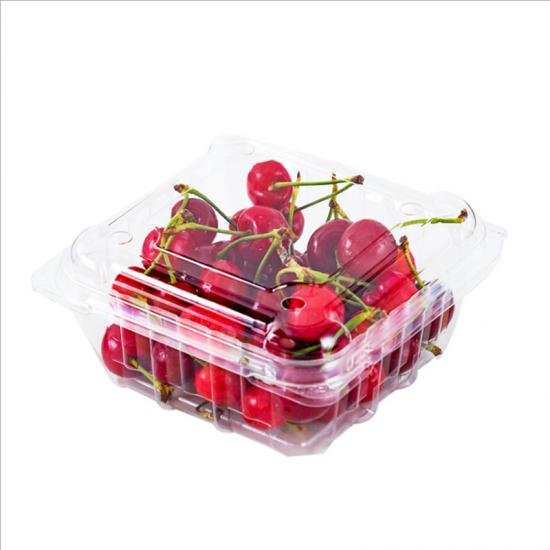
Roll-fed RPET sheet formed into fresh-produce clamshells with traceable recycled content.
Returnable and washable trays — roll-fed PP
PP sheet is often preferred where heat resistance and lower material density matter. A Tier-1 auto-parts supplier and logistics packaging integrator in Poland and Thailand used approximately 900 t per year for returnable trays and line-side carriers, reporting 80+ wash cycles without warping and full recyclability at end of loop.
Toy and retail blisters — roll-fed PET with downstream die-cutting and sealing
Where blister cards are die-cut and heat-sealed, the format has to serve both the former and the sealing line. A toy brand owner and OEM toy manufacturer in Germany and the United States used approximately 800 t per year, reporting drop-test cracking reduced from 3.2% to 0.4% and sealing scrap down 18%.
Electronics trays — HIPS with controlled electrical properties
Not every electronics package requires anti-static or ESD material; the requirement depends on component sensitivity and the customer's electrostatic-control system. Where controlled surface resistance is required, antistatic and conductive black HIPS options exist. An EMS provider and component distributor in Vietnam and Mexico used approximately 600 t per year for PCBA and IC trays, holding surface resistance at 10⁴–10⁸ Ω after 20+ reuse cycles.

Antistatic HIPS sheet formed into PCBA handling trays with controlled surface resistance.
Oral-care and personal-care blisters — roll-fed PET with a wide sealing window
Toothbrush and oral-care blister cards, travel-kit trays and cosmetic insert trays depend on stable sealing and clean die-cutting. An oral-care brand owner and personal-care contract packer in Indonesia and Brazil used approximately 700 t per year and reported a 15% pack-line speed increase after sealing-window optimization, with hang-tab breakage complaints below 0.1%.
Comparison Table: Roll-Fed vs. Sheet-Fed at the Purchase-Order Level
| Decision factor | Roll-fed | Sheet-fed | What to fix in the order |
|---|---|---|---|
| Material delivered | Continuous roll of thermoforming sheet | Pre-cut sheets | Format plus ordering unit |
| Machine interface | Unwinding system: shaft or chuck, tension, roll handling | Sheet feeding and stacking | Equipment limits confirmed before ordering |
| Width control | Roll width from mold layout, product arrangement and trim allowance | Sheet width from mold layout | Width and trim allowance |
| Geometry parameters | Roll diameter, roll weight, core inner diameter | Sheet length, sheet count, stack condition | Exact dimensions, not a range |
| Typical fit | Continuous, higher-volume packaging runs | Thick-gauge parts, large parts, short runs, validation batches | Volume and MOQ basis |
| Handling risk | Curl, roll deformation, feeding alignment | Sheet flatness, edge quality, stack stability | Storage and handling expectations |
| Purchasing terms | MOQ by material and specification; EXW, FOB, CIF; other Incoterms on agreement; T/T | Same term structure, quoted per sheet specification | MOQ, Incoterm, payment terms |
| Acceptance criteria | Specification verification, thickness and width inspection, appearance inspection, finished-product inspection before shipment | Same checks applied to sheets | Third-party inspection on request |
| Best-fit materials | PET for clarity and stiffness; PP for heat resistance and cups; HIPS for trays, inserts and ESD parts | Same material family, selected by gauge and part geometry | Material plus functional property |
The table compares formats, not brands. Material properties described here follow the PET, PP and HIPS specifications referenced above; values such as MOQ, lead time and capacity are supplier-specific and should be confirmed per specification.
Frequently Asked Questions
Which compliance documents should a buyer request for a food-contact PET thermoforming plastic sheet roll?
Request documents that name the exact material and scope. For PET sheet, Pulixin Packaging Materials (Shanghai) Co., Ltd. holds FSSC 22000 certification CQM25FSSC00171, valid to 2028-07-03, with the certified scope stated as the production of specific PET sheets for food contact applications. System certificates include ISO 9001:2015 (00226Q03336R101) and ISO 14001:2015 (00226E02412R101), both valid to 2029-06-24 with the scope stated as the production of polyester sheets (PET). Product-level testing is covered by SGS report SHAPH26002960101 for PET sheet against EU RoHS Directive 2015/863, and recycled content is covered by GRS scope certificate SGC-GRC09372-GRS-2026-04, valid to 2027-04-22. Destination-market food-contact rules such as EU 10/2011 should be confirmed separately, because food-contact compliance cannot be assumed from a certificate title alone.
Can an OEM supplier produce PET thermoforming plastic sheet roll for food packaging to a custom specification?
Yes. OEM and custom manufacturing are available, and customization covers material (PET, PP, PS/HIPS), thickness, width, color, transparency, surface finish, roll size, functional properties, and packaging and labeling. Production runs on 14 co-extrusion lines with an annual output above 40,000 tons and a monthly capacity of approximately 3,500 tons, which may vary with the production schedule and product specifications. Technical support covers material selection, thermoforming application and product specification, so a buyer can define thickness, width and structure from the finished part rather than from a generic catalogue entry.
What are the MOQ, delivery terms and payment terms?
MOQ varies by material and specification: standard PET is 5 tons and standard PP or PS is 3 tons, while customized products may be subject to different MOQ requirements depending on material, thickness, width, color and customization. Delivery terms offered are EXW, FOB and CIF, with other Incoterms available upon agreement. Payment is by T/T, with specific terms subject to order value, customer requirements and mutual agreement. Because the MOQ basis differs between roll stock and cut-sheet supply, the format should be stated in the inquiry.
How can a buyer validate a format or a new supplier before bulk orders?
Validation should combine documents and a controlled trial. Quality control covers raw material inspection, thickness and width control, appearance inspection, in-process quality control and finished-product inspection, with third-party testing available when required and third-party inspection available before shipment upon request. For a supplier change, use the currently proven sheet specification as the comparison baseline: compare sheet structure, thickness tolerance, width, roll configuration, color or transparency and forming behaviour, then run a controlled production trial before regular-volume orders. Avoid changing material structure, thickness and process settings at the same time, because that makes the source of any forming difference impossible to identify.
What lead time should be planned for a thermoforming sheet roll order?
Delivery time generally ranges from 7 to 15 days, depending on the material, specifications, order quantity and any customization requirements. Buyers running a new format, a new mold or a newly qualified supplier should budget additional time for the trial itself, because the trial — not the delivery — is usually the step that determines whether the line runs at target. To start a specification review, send the finished-part drawing or sample, material preference, thickness and width, roll or sheet dimensions, estimated quantity and destination to operation01@pulixin.com, or download the PULIXIN catalogue (PDF) for the full material and format list.
Conclusion
Roll-fed and sheet-fed are two ways of delivering the same material family to the forming machine, and the right answer is determined by the equipment interface and the mold, not by habit. Roll-fed suits continuous packaging lines where roll width, roll diameter, roll weight and core inner diameter are specified against the unwinding system. Sheet-fed suits thick-gauge, large or shorter-run work where sheet geometry, flatness and stack condition become the controlling parameters.
Whichever format is chosen, the purchasing discipline is the same: specify material, structure, thickness with tolerance, width and geometry together; match compliance documents to the exact material; state MOQ, Incoterm and payment terms per specification; and agree acceptance criteria — specification verification, thickness and width inspection, appearance inspection and finished-product inspection — before shipment. A controlled trial before regular-volume orders remains the cheapest way to find out whether a specification actually fits a line.
Next step: review your specification against the machine
Send the finished-part drawing or sample, material preference, thickness, width, roll or sheet dimensions and destination market, and the PULIXIN team will confirm a suitable PET, PP or HIPS thermoforming plastic sheet roll specification for your line.
Email: operation01@pulixin.com · Tel / WhatsApp: +86 13818585204 · Website: www.pulixin.com · Catalogue: download the PULIXIN catalogue (PDF)
Pulixin Packaging Materials (Shanghai) Co., Ltd., No.32 Lubin Rd, Luyuan Industrial Zone, Pudong, Shanghai, China. Founded 2009.
Have Questions or Need More Details?
Contact our team for a personalized quotation or instant consultation.
Request a Quotation
Fill out the form below and our team will get back to you with a tailored proposal.
WhatsApp Direct Chat
Prefer to chat in real-time? Message us on WhatsApp for instant assistance & quick answers.
- Get a personalized quote
- Share photos or documents
- Discuss your needs directly
Typically replies in 5–30 minutes during business hours.