
Thermoforming Sheet Roll Supplier: Print & Converting Audit
Thermoforming Sheet Roll Supplier: Print & Converting Audit
A supplier can be a dependable source of thermoforming plastic sheet roll and still be the wrong partner for a printing programme. Those are two different capabilities, verified through two different sets of evidence — and the gap usually surfaces only after a printed pallet fails an ink-adhesion check or a laminated sheet blisters on the forming line.
This audit framework is written for packaging converters in the evaluation and execution stages. It sets out what to inspect in screen, UV and digital printing equipment and in cutting and laminating machinery, how to confirm that the sheet is a genuine printing substrate rather than a generic roll, what clean and dry indoor storage actually requires, and how to convert the findings into purchase-order terms and acceptance criteria that hold up in production.
What “Printing and Converting Support” Should Mean
The first audit step is definitional. “We support printing” is not a specification, and it should not appear in a supplier evaluation without a level attached to it. Three levels are usually on offer, and they carry very different obligations.
- Level A — substrate supply. The supplier delivers roll stock to an agreed material, thickness, width and roll specification. Print and converting capability belongs entirely to the buyer.
- Level B — print-ready substrate plus documented controls. The supplier controls surface finish, thickness consistency, width accuracy and flatness within stated tolerances, supplies supporting test documentation, and provides technical support when a print or forming problem appears.
- Level C — downstream services. The supplier operates, or formally manages through a named partner, screen, UV or digital printing, die-cutting or sheeting, and lamination.
A converter buying Level A and expecting Level C behaviour is the most common source of disputes in this category. A supplier offering Level C without evidence of the equipment is the second. The audit should therefore open with one written question: which level is being offered, on which site, with which equipment list. Everything that follows tests whether that answer is true.
Why Thermoforming Sheet Is Audited Differently from Film or Board
Printing on a rigid thermoforming sheet involves mechanics that flexible film and paperboard audits do not face. Three properties dominate.
Heat exposure after printing. PET thermoforming typically occurs between 266°F and 320°F (130°C to 160°C), according to South Plastic (SPI). When print is applied before forming, the ink system and any laminated layer pass through that window. This is why the audit must establish the print-to-form sequence before it evaluates colour or registration — an ink that performs well on flat sheet may behave differently once the same sheet is drawn into a tray.
Roll geometry and flatness. Sheet curl can originate in material structure, residual stress, winding, storage conditions, temperature change or moisture and handling. Unstable flatness translates into feeding and registration variation on a printing or cutting line before it ever reaches the former. Curl is therefore a print-support issue, not only a forming issue, and the audit should treat it that way.
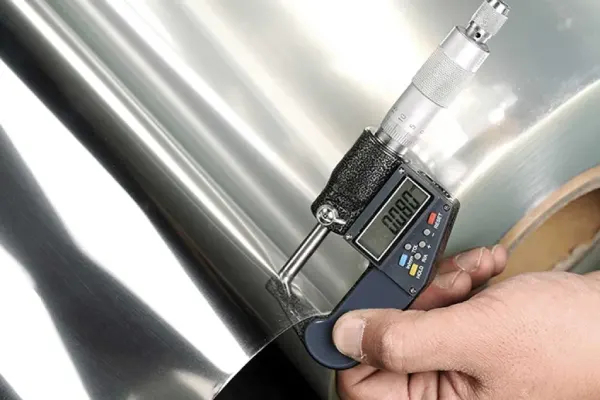
Thickness consistency. Thickness variation affects heating, forming consistency, part weight and final wall distribution. On a printing line it also affects nip pressure, ink transfer and cut registration. A supplier who cannot state its thickness and width control method cannot credibly support a printing programme.
Verification Module A: Screen, UV and Digital Printing Equipment
Where a supplier claims printing support, the claim should be converted into verifiable equipment and process evidence. Brochures and website galleries are not evidence; a witnessed run on your own sheet is.
What to request
- An equipment list by process — screen, UV or digital — stating format limits, number of colours, curing method and the maximum and minimum sheet thickness the line can handle.
- A written statement of what is performed in-house and what is subcontracted, with the name of any subcontractor.
- A sample printed sheet from a comparable job, accompanied by a process record: substrate batch, ink series, pre-treatment if used, cure conditions, and colour measurement method.
- Colour control documentation: the measurement instrument used, the reference standard, and the agreed tolerance.
- An ink-adhesion test result on the specific sheet you intend to buy, not on a generic sheet.
What to look for on site
Ask to see the pre-treatment step if surface treatment is claimed, the curing unit in operation, and the rejects area. A print line that has no defined reject handling at the end of the line is a line that has not been audited internally. Inspect how printed sheets are stacked, interleaved and stored before forming, because print damage frequently happens after the printing step rather than during it.
If printing is subcontracted, bring the subcontractor into the audit scope. A named partner with an unnamed process is not a verified capability.
Verification Module B: Cutting and Laminating Machinery
Cutting and laminating failures are quieter than printing failures and often appear later, during forming or at the customer's filling line. Four checks cover most of the risk.
- Sheeting and slitting accuracy. Confirm the dimensional tolerance held on cut sheets and slit rolls, and inspect edge quality — ragged or compressed edges indicate worn tooling and cause feeding problems downstream.
- Die-cutting. For printed cards, blisters and inserts, confirm the die-cutting format, the registration method relative to printed graphics, and the condition of the cutting plate.
- Lamination. Where a film is laminated to the sheet, ask for bond strength evidence, the lamination temperature and pressure record, and a delamination check after a heat cycle representative of your forming conditions.
- Flatness after processing. A sheet that was flat on receipt can curl after lamination or printing. Ask how processed stock is conditioned and how flatness is verified before dispatch.
Verification Module C: The Substrate Evidence Behind Printability
Print support ultimately rests on the sheet. PULIXIN Thermoforming Plastic Sheet is the rigid PET, PP and PS/HIPS sheet roll range produced by Pulixin Packaging Materials (Shanghai) Co., Ltd., a Shanghai-based manufacturer founded in 2009 operating a 20,000㎡ production base and 14 co-extrusion lines.
The customization scope defined for this range lists material (PET, PP, PS/HIPS), thickness, width, colour, transparency, surface finish, roll size, functional properties, and packaging and labelling. For a converter, the two entries that matter most in a print audit are surface finish and thickness — one determines ink behaviour, the other determines registration and cut accuracy.
Two supplied project records show how those variables are handled in practice. In a toy-packaging programme in Germany and the United States (approximately 800 t per year, three and two years respectively), a printable surface was listed among the supplied highlights for action-figure clamshells and carded blisters; the recorded results included drop-test cracking reduced from 3.2% to 0.4% and sealing scrap reduced by 18%. In an oral-care blister programme in Brazil and Indonesia (approximately 700 t per year), the documented highlights included a wide sealing window and tear and puncture resistance, with hang-tab breakage complaints recorded below 0.1%. Neither record proves printability for your specific artwork, ink system and forming depth — that still requires your own trial — but both show the type of evidence a supplier should be able to produce when a surface or sealing claim is made.
What the audit should reject is a general assertion of “excellent printability” with no sheet-specific test behind it. Printability depends on the ink, the pre-treatment, the curing and the sheet together, and a competent supplier will say so.
Clean, Dry Indoor Conditions: Auditing Storage and Handling
Print and converting quality is partly a warehouse question. Temperature, humidity, direct sunlight, packaging condition and storage time can all influence sheet condition before processing, and proper storage under suitable workshop conditions helps prevent avoidable feeding problems. Storage method should follow the supplier's packaging and handling recommendations to avoid roll deformation or edge damage.
An audit of conditions should cover:
- Recorded temperature and humidity in the roll store, and whether the store is enclosed, dry and shielded from direct sunlight.
- Roll orientation and support during storage and transport, following the supplier's handling recommendation.
- Packaging integrity on receipt, including moisture protection and edge protection.
- FIFO control, so aged stock is not released into a print run first.
- Conditioning time between unwrapping and printing, and a defined check for flatness before the roll is loaded.
If curl or uneven feeding appears, the correct response is diagnosis rather than an immediate material change. Determine whether the source is the sheet, the storage, the winding, the transport or the machine feeding conditions before altering the specification.
The Documentation Pack: What the Certificates Actually Cover
Certificates are the easiest evidence to collect and the easiest to misread. Each document has a subject and a scope, and neither can be extended to printing services or to products outside the named scope.
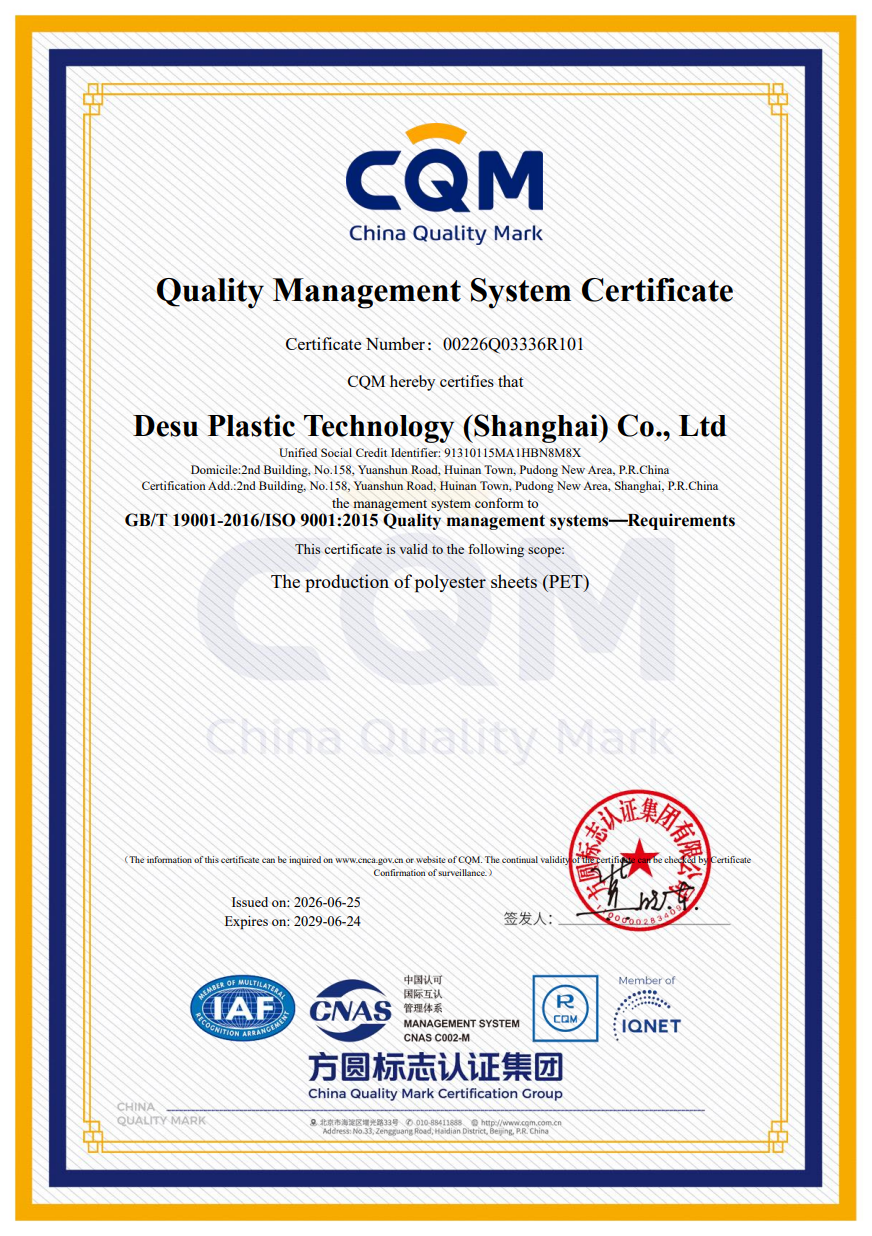
- ISO 9001:2015 — certificate 00226Q03336R101, issued by China Quality Mark Certification Group (CQM) on 2026-06-25 and valid to 2029-06-24, scope: the production of polyester sheets (PET).
- ISO 14001:2015 — certificate 00226E02412R101, CQM, issued 2026-06-25, valid to 2029-06-24, scope: the production of polyester sheets (PET) and related management activities.
- FSSC 22000 — certificate CQM25FSSC00171, issued 2025-07-04 and valid to 2028-07-03, scope: production of specific PET sheets for food contact applications (plasticizing extrusion).
- Global Recycled Standard (GRS) v4.0 — certificate SGC-GRC09372-GRS-2026-04 issued by SGS-CSTC on 2026-04-23, valid to 2027-04-22, covering processed post-consumer materials, processed pre-consumer materials and the extrusion process.
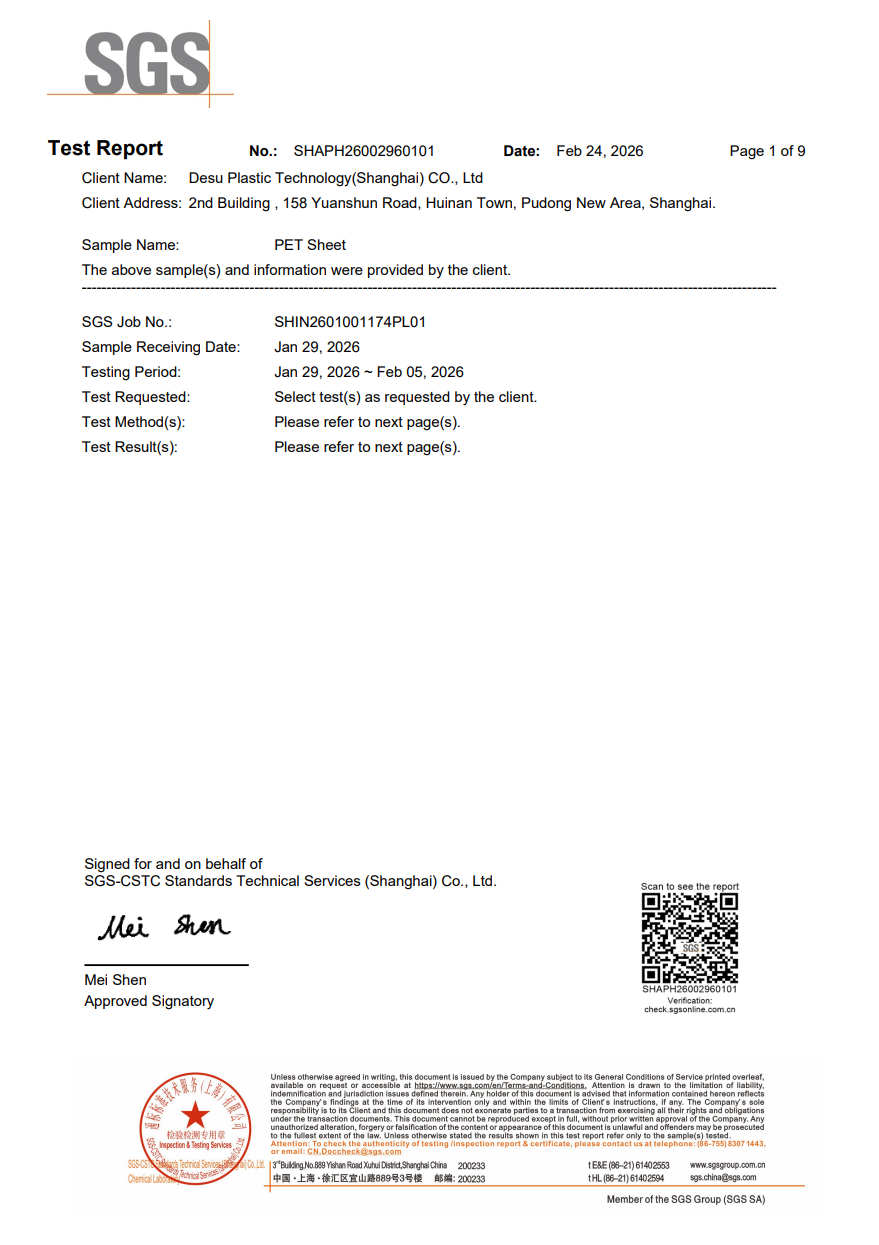
- SGS test reports — PET sheet (SHAPH26002960101), PS black (SHAPH26002958403), PS white/natural (SHAPH26002958401) and PP white/natural (SHAPH26002958405), all against EU RoHS Directive (EU) 2015/863, plus a report for PET with aluminium plating (SHAAF25013706405).
Two scope notes belong in the audit file. The ISO 9001 and ISO 14001 scopes reference polyester (PET) sheets, so they do not by themselves certify a PP or HIPS production line. The RoHS reports are material-restricted-substance results for the named sheets, not printability tests and not food-contact clearance for a printed, converted article.
For food-contact printed packaging, the applicable framework must be confirmed between buyer and supplier, since EU Regulation (EU) No 10/2011 governs plastic materials and articles intended to come into contact with food. Whether a given ink and substrate combination is suitable for a specific food application is an assessment, not a document a sheet supplier can issue on its own.
Audit Evidence Matrix
The table below maps each document to what it proves and what it leaves open. It is designed to be pasted into the audit file with the buyer's own notes added.
| Evidence item | What it verifies | What it does not verify |
|---|---|---|
| Equipment list with formats and processes | That screen, UV or digital lines exist on the stated site | That those lines run your substrate at your thickness |
| Witnessed print run on your sheet | Actual process performance on your material | Long-run consistency across batches |
| Ink-adhesion test result | Bond of a named ink to a named sheet | Performance after forming at 130–160°C |
| Thickness and width inspection records | Dimensional control in the supplied batch | Print registration on your press |
| ISO 9001 certificate with scope | A certified QMS for the scoped product | Certification of out-of-scope materials or services |
| SGS RoHS report for the named sheet | Restricted-substance compliance for that material | Food-contact suitability of a printed article |
| Storage and handling records | Conditions up to the point of dispatch | Conditions inside the buyer's own warehouse |
Turning Audit Findings into Purchasing Terms and Acceptance Criteria
An audit that does not change the purchase order has produced information but no protection. The commercial and quality clauses below are the practical output of the review.
Commercial terms to confirm in writing
- MOQ by specification. For this supplier, standard PET MOQ is 5 tons and standard PP or PS MOQ is 3 tons; customized products may carry different minimums, so MOQ must be confirmed per specification rather than assumed from the material family.
- Delivery terms. EXW, FOB and CIF are offered, with other Incoterms available on agreement.
- Payment terms. T/T, with the specific terms subject to order value and mutual agreement.
- Lead time. Generally 7 to 15 days depending on material, specification, order quantity and customization. Against a monthly production capacity of approximately 3,500 tons, this is the figure to test with a trial order rather than accept on a quotation sheet.
Acceptance criteria to write into the order
The supplier's standard acceptance basis covers specification verification, thickness and width inspection, appearance inspection and finished-product quality inspection before shipment, with third-party inspection available on request. A printing programme usually needs additional clauses, and the audit should establish whether the supplier will accept them:
- An approved printed reference sample, signed by both parties, retained for the life of the order.
- An agreed colour measurement method and tolerance, with the instrument and reference standard named.
- An ink-adhesion test method and pass threshold for the specific ink and sheet combination.
- Roll or sheet flatness and dimensional limits, measured on the delivered batch.
- Packaging and labelling to an agreed specification, including moisture and edge protection.
- A written change-notification clause: any change in resin source, surface finish or production line requires re-approval before shipment.
- A defined nonconformance path covering quarantine, root-cause report and rework or replacement.
Which Converter Profiles Need Which Audit Level
The depth of the audit should match what the converter actually outsources. A food-tray producer that forms its own trays and buys printed lids needs Level B evidence on the lid sheet plus lamination or print verification; a blister-card converter buying printed card stock alongside clear sheet needs Level C evidence, because the printed surface is part of the delivered product. Export-focused converters supplying retail programmes typically need the documentation pack and a witnessed run, since retail audits tend to ask for both.
The practical sequence is the same in each case: document request, remote review, sample run on your own specification, witnessed run, contract clauses, first-article approval, then volume release. Compressing the sequence is where most print-related claims fail.
FAQ
What should a converter verify in an OEM PET thermoforming plastic sheet roll manufacturer for food packaging?
Verify four things: the OEM and customization scope, the food-contact documentation, the dimensional control method, and the commercial terms. On the first point, OEM and custom manufacturing are offered, with customization covering material, thickness, width, colour, transparency, surface finish, roll size, functional properties, and packaging and labelling. On the second, the FSSC 22000 certificate CQM25FSSC00171 covers production of specific PET sheets for food contact applications (plasticizing extrusion), valid to 2028-07-03, and the SGS report SHAPH26002960101 covers PET sheet against EU RoHS 2015/863. On the third, quality control runs from raw material inspection through thickness and width control, appearance inspection, in-process control and finished-product inspection. On the fourth, standard PET MOQ is 5 tons and lead time is generally 7 to 15 days.
How do I verify screen, UV or digital printing support instead of accepting a brochure claim?
Convert the claim into equipment and process evidence. Ask for an equipment list by process with format and thickness limits, a statement of what is in-house versus subcontracted, a printed sample from a comparable job with its process record, the colour measurement method and tolerance, and an ink-adhesion result on the sheet you intend to buy. Then request a witnessed run on your own material. A capability is verified when equipment, process record and a physical result on your substrate are all present; any one alone is still a claim.
What evidence shows that the sheet is a suitable printing substrate?
Three categories: dimensional control, surface control and application evidence. Dimensional control means documented thickness and width inspection, because variation affects registration and cut accuracy. Surface control means a defined surface finish within the customization scope, since finish drives ink behaviour. Application evidence means a project record where printability was part of the supplied specification — for example, a toy-packaging programme in Germany and the United States where a printable surface was listed among the highlights. None of this replaces your own trial with your ink and forming depth.
What acceptance criteria should be written into the purchase order?
Start from the standard basis — specification verification, thickness and width inspection, appearance inspection and finished-product quality inspection before shipment, with third-party inspection available on request — then add print-specific clauses: a signed printed reference sample, an agreed colour measurement method and tolerance, an ink-adhesion test method and threshold, flatness and dimensional limits on the delivered batch, packaging and labelling to specification, a change-notification clause, and a defined nonconformance path.
How should rolls be stored before printing and converting?
Store indoors in clean, dry, enclosed conditions, shielded from direct sunlight, with temperature and humidity recorded. Follow the supplier's packaging and handling recommendation for roll orientation, keep packaging intact until release, and apply FIFO so aged stock is not printed first. Temperature, humidity, direct sunlight, packaging condition and storage time can all influence sheet condition, and proper storage under suitable workshop conditions helps prevent avoidable feeding problems. If curl appears, diagnose whether the source is the sheet, winding, transport, storage or machine feeding before changing the specification.
What commercial terms and next steps should be confirmed before a printed trial?
Confirm MOQ per specification (standard PET 5 tons, standard PP or PS 3 tons, customized products subject to different minimums), delivery terms (EXW, FOB, CIF, other Incoterms on agreement), T/T payment terms, and lead time of generally 7 to 15 days. Then request a sample batch against your written specification so the print and converting trial runs on the material you will actually buy. PULIXIN Thermoforming Plastic Sheet documentation, including the full range overview, is available in the PULIXIN product catalogue (PDF), and a sample or quotation request can be raised through the contact details published on the company website.
Conclusion
Auditing printing and converting support is an exercise in separating three things that are usually presented together: the sheet, the documentation and the equipment. The sheet is verified through thickness and width control, surface finish and storage discipline. The documentation is verified by reading the scope line on each certificate rather than the title. The equipment is verified only by a witnessed run on your own material.
For converters moving from evaluation into execution, the practical test is simple. If a supplier cannot state which support level it offers, cannot show a process record behind a printed sample, and will not accept print-specific acceptance clauses in the purchase order, then the printing programme is being planned on assumptions. The audit exists to replace those assumptions with evidence before the first production pallet is committed.

Have Questions or Need More Details?
Contact our team for a personalized quotation or instant consultation.
Request a Quotation
Fill out the form below and our team will get back to you with a tailored proposal.
WhatsApp Direct Chat
Prefer to chat in real-time? Message us on WhatsApp for instant assistance & quick answers.
- Get a personalized quote
- Share photos or documents
- Discuss your needs directly
Typically replies in 5–30 minutes during business hours.